
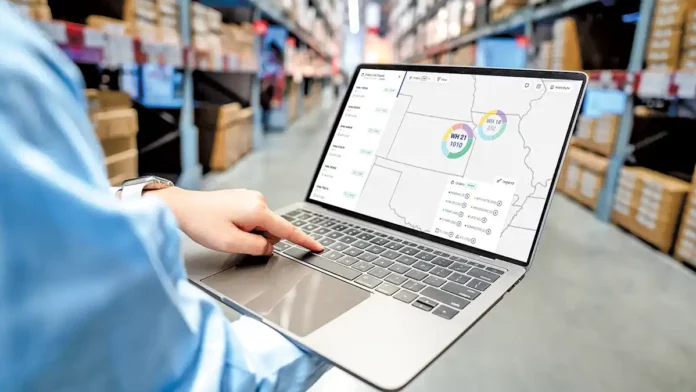
The Technology Blind Spot
Most food brands invest heavily in what the customer sees. Rightfully so, their money goes into creating a great product along with prominent packaging and a brand that tells their story. What’s equally critical is the technology running the supply chain behind it. Brands that choose 3PL partners based on price and location alone without evaluating their technology stack and innovation roadmap are making a decision that will constrain them within two to three years.
Can Your Technology Handle Your Growth?
Growth is where most cold chain strategies get exposed as it inevitably increases risk.
A brand shipping a few hundred parcels a month from one facility can manage operations with disciplined processes. Scale that to tens of thousands of parcels across a national network, and the math changes entirely as variables compound and decision points multiply.
Complexity comes with growth, and if brands don’t have solid technology systems established, no amount of experienced headcount can substitute for the systems that should have been in place.
Three Decisions That Can’t Be Made in Isolation
The importance of integration as a technological capability can’t be stated enough. Every shipment, especially for cold chain brands, involves three interdependent decisions.
Inventory placement determines transit time. Transit time determines packaging requirements, which affects both cost and risk. Positioning inventory too far from your end-customer requires more robust, expensive packaging to protect the product across a longer journey. You also limit carrier options in doing so.
Packaging logic that isn’t directly tied to the weather throughout the shipment’s journey leads to consequences in both directions. Under-packaging compromises the product’s integrity, resulting in unsatisfied customers. On the other hand, over-packaging means you’re spending on insulation and coolant that isn’t necessary. What solves this is a system that evaluates weather conditions with product temperature sensitivity in mind. That’s a solvable engineering problem, and it produces immediate ROI.
Transportation planning that’s disconnected from the inventory system produces a scenario that’s preventable: an order is picked and packed perfectly, but then it’s handed to a carrier whose actual transit time exceeds the package’s thermal protection window. The WMS shows the order shipped correctly, and the carrier reports an on-time delivery. However, the product arrives damaged since the transportation and packaging decisions weren’t aligned.
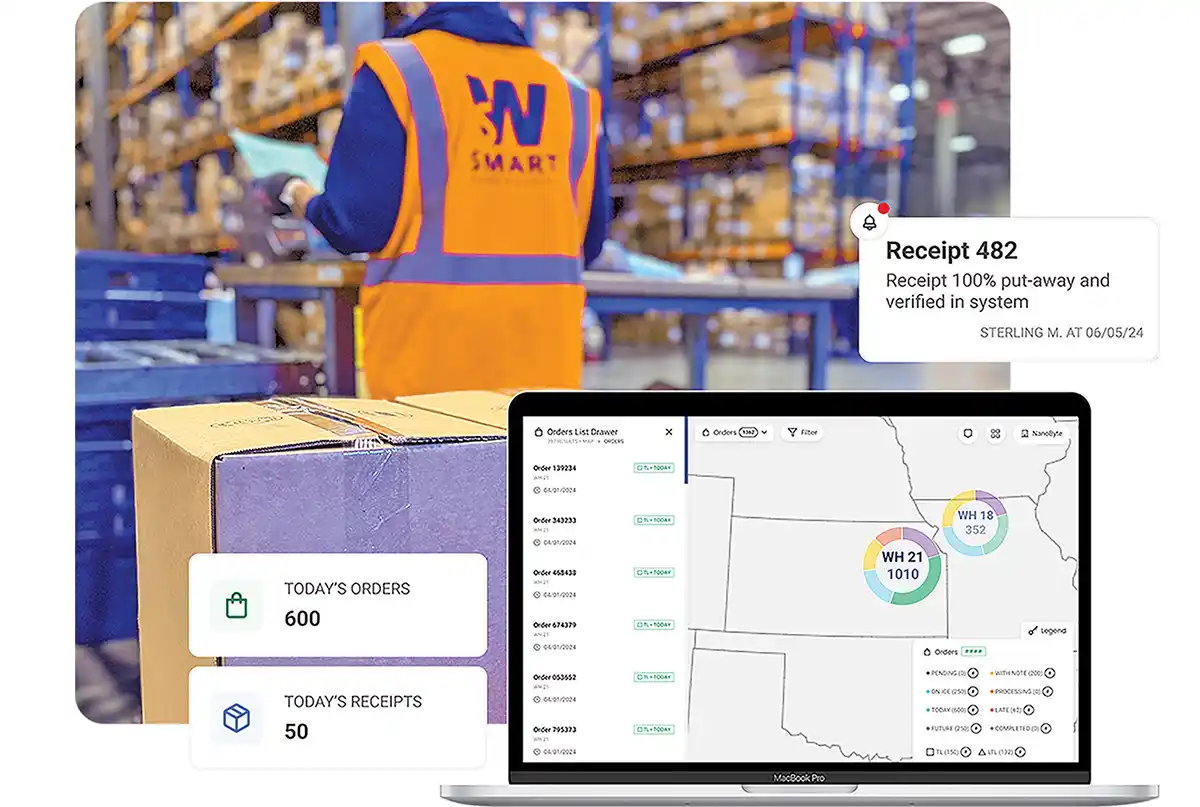
This is a fundamental problem that integrated platforms, like Smart Warehousing’s tech stack, solve. Smart’s innovative technology, including SWIMS and Smart Visibility were designed to work together as a single ecosystem. SWIMS (Smart Warehousing Information Management System) serves as the source of truth and system of record for warehouse operations, while Smart Visibility gives customers a real-time, centralized view of everything happening across their supply chain.
What “Technology-First” Actually Means
Most fulfillment providers approach technology the same way. Buy an off-the-shelf WMS, configure it as best they can, work around its’ limitations, and call it good. The problem is that most of those systems were designed only for ambient products in a single facility. Multi-temperature environments, lot level traceability, FEFO pick logic, and packaging optimization gets put on as an afterthought. That afterthought is exactly where failures hide for food and beverage brands.
Smart built SWIMS from the ground up, designed to be completely customizable for the unique demands of each business. Intentionally built to scale as needed for our customers, we treat technology as a core competency rather than a support function.
When we’re talking about the technology maturity model, there’s three phases to acknowledge.
- Phase 1 – Digitization: Integrating data into the system.
- Phase 2 – Visibility: Making that data accessible in real time. This is where Smart Visibility operates, providing real-time dashboards, transaction-level inventory data, KPI reporting, and centralized alerts.
- Phase 3 – Intelligence: Using AI and predictive analytics to act on that data automatically.
The important thing to note is the architecture built in phases one and two determines whether you can ever reach phase three. If your data is siloed and your systems are disconnected, layering AI on top of that foundation essentially means nothing. The path to running an efficient supply chain is linked to the quality of your infrastructure.
This is why Smart made the decision to build and maintain our own platforms with an in-house engineering team. If our operations or customers need a capability, we build it. From my perspective, that ownership of the tech stack is the single, most important strategic decision Smart has made. It means our roadmap is driven by what our customers actually need.
What Brands Need to Be Aware Of
An area that food and beverage brands need to be on top of is traceability, especially compliance with FSMA 204.
FSMA 204 is a federal regulation mandating enhanced lot-level traceability for high-risk foods, including a variety of cold chain products. This rule introduces a new, special barcode, or as I refer to them as “monster barcodes”, that will soon be displayed on products. Under this regulation, businesses must be able to provide Critical Tracking Events and Key Data Elements to the FDA in an electronic, sortable format within 24 hours of a request. This sort of action is not achievable with disconnected systems or summary-level reporting. FSMA 204 will go into effect in July of 2028, but those who treat this as a future problem instead of addressing it now, run the risk of a detrimental and expensive catch-up.
Beyond compliance, traceability infrastructure is what separates a manageable recall from a brand crisis. If your system tracks lot-to-order relationships at the transaction level, a recall means pulling a list of affected customers in minutes and executing a targeted response. If it doesn’t, you’re issuing a broad recall while manually reconstructing records, and the reputational and financial damages increase.
SWIMS is compliant and tracks inventory at the lot level all the way from receipt through final shipment. When the FDA comes asking, the answer is ready. That’s the difference between a system built for cold chain and one that was adapted for it.
Start With the Right Questions
The technology managing your supply chain is either building toward something or falling behind something. For any growing brand, it’s worthwhile to evaluate what your infrastructure can and can’t do today. Can your fulfillment partner tell you in real time which lots are moving and how every order is being packed? Are your inventory, packaging, and transportation decisions connected? Is your operation built to absorb the complexity that comes with scaling? The right infrastructure protects what you’ve built and makes the next stage of growth possible.
To learn more about how Smart Warehousing’s technology platforms support food brands at every stage of growth, visit smartwarehousing.com.

Tom Graham is the Chief Information Officer at Smart Warehousing, a technology-enabled third-party logistics (3PL) provider with a nationwide network of warehouse locations. In his role, Tom leads the company’s overall technology strategy, overseeing IT, integrations, and product development. Together, these teams build the tools and platforms that power Smart Warehousing’s operations and client experience. With over 25 years of experience in logistics and a background in mechanical engineering, Tom brings a uniquely analytical perspective to technology leadership. His career spans IT and software development roles across the logistics industry, where he has consistently focused on developing and optimizing software solutions that deliver measurable value to customers. Tom is known for translating complex technical challenges into practical, scalable solutions, from proprietary warehouse management systems to end-to-end visibility tools. His engineering mindset and deep industry expertise make him a leader in logistics innovation, helping Smart Warehousing and its’ customers use technology as a competitive advantage.