
Most corporate headquarters have some combination of cameras, access badges and visitor logs in place, but few have tested whether those layers actually work together under pressure. Security leads and facility managers ready to request a physical security audit for their NYC headquarters owe it to their teams to find out. A structured and independent review reveals what daily familiarity with a building often conceals.
The Anatomy of a Corporate Physical Security Audit
A physical security audit examines a building’s defenses layer by layer, from perimeter barriers and access controls to interior surveillance systems and alarm networks. Security experts like Beau Dietl & Associates conduct these assessments by sending trained investigators to walk the site, test entry points and review protocols against industry standards.
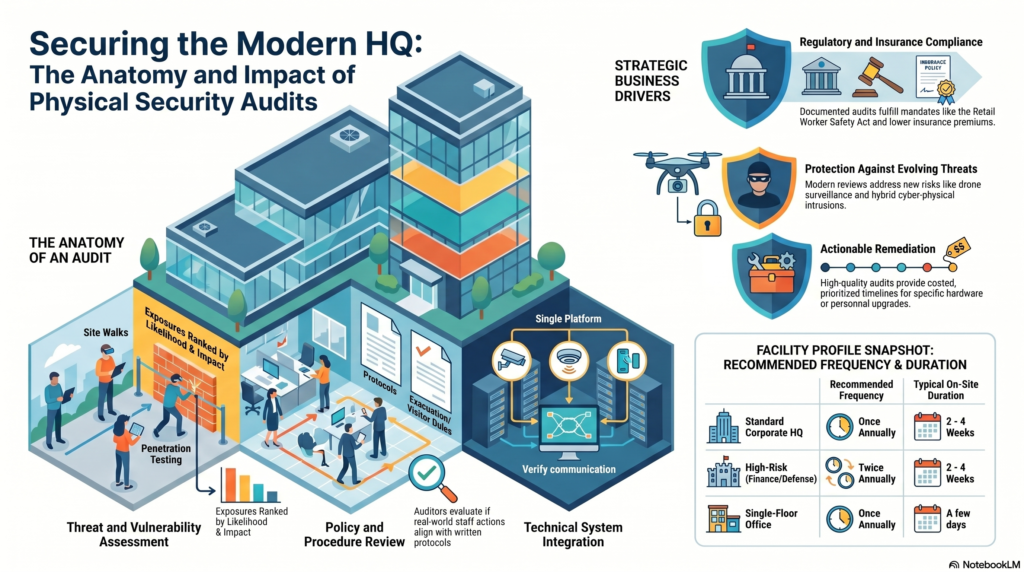
Initial Threat and Vulnerability Assessment
Auditors begin by identifying who and what could target the facility. They note external threats, such as forced entry and tailgating, as well as internal risks, such as unauthorized after-hours access. The assessment traces each point of vulnerability to specific areas of the building. After that, the auditor creates a risk matrix that ranks exposures by likelihood and impact.
The security auditing process often includes penetration testing, in which specialists attempt to bypass security controls without notifying staff. Beau Dietl & Associates details one such engagement in its authorized breach case study, showing how a controlled intrusion surfaced security gaps that a paper review alone would have missed.
Policy and Procedure Review
Auditors evaluate the written policies governing daily security operations, including visitor management protocols, badge procedures, key control logs and emergency response plans. A security team may have a thorough evacuation plan in writing, yet floor wardens might not be aware of their assigned roles.
Physical Security System Integration
Modern corporate offices rely on overlapping technology, using a combination of card readers, CCTV cameras, intrusion alarms and intercoms. It is the auditors’ job to verify that these systems communicate with one another and feed into a single monitoring platform. Outdated firmware, unmonitored blind spots and inconsistent recording schedules rank among the most common findings. Organizations with integrated platforms reported faster incident response times.
Why Do You Need a Physical Security Audit for Your Headquarters?
A high-profile operation, as with a corporate headquarters, often faces security pressures that require a customized approach. For example, an audit tailored to a dense office in New York accounts for building-specific factors, such as shared lobbies, public transit adjacency and vertical evacuation routes that suburban campuses rarely face.
Meeting Regulatory and Insurance Mandates
Many U.S. states and city agencies have boosted workplace safety requirements in recent years. The Retail Worker Safety Act requires covered employers to adopt workplace violence prevention policies and conduct annual risk assessments. Insurance providers even factor security posture into premium calculations, and having a documented audit can help strengthen an organization’s position when it’s time to renew.
Protecting People, Assets and Reputation
The safety incident at 345 Park Avenue in 2025 reminded corporate tenants that workplace violence can strike even in premier office towers. A physical security audit points out the specific measures, from lobby screening to duress alarms, that can reduce the risk of harm to employees and visitors. It also protects a company’s proprietary data and brand standing by exposing weaknesses before an adversary does.
Preparing for Evolving Threats
Threat profiles change as technology and attack strategies evolve. Drone surveillance of executive floors and social engineering of front-desk staff represent newer attack vectors that a five-year-old security plan might not even recognize. Industry observers noted a rise in hybrid threats that blend cyber and physical intrusion. That said, conducting routine audits can keep defensive measures up to date.
Choosing the Right Partner for Your Security Audit
More than comparing price quotes, audit quality depends on the experience, methodology and discretion of the team conducting it.
Prioritize Experience With Corporate HQs
A firm that has assessed Fortune 500 headquarters understands the sensitivities of large office environments. Established in 1985, Beau Dietl & Associates brings decades of corporate security work to each engagement, including armed and unarmed guard deployment, executive protection and site development security. That experience enables auditors to benchmark a client’s posture against comparable properties.
Ensure Discretion and Confidentiality
A security audit exposes an organization’s weakest points. That said, the auditing firm must handle findings with strict confidentiality and share results only with authorized individuals. Beau Dietl & Associates maintains controlled distribution protocols for assessment reports to prevent unnecessary leakage of sensitive information.
Demand Actionable Recommendations
A final audit report should rank findings by severity, assign ownership for each remediation task and include realistic timelines. Vague recommendations like “improve access control” do not offer clear directions. The best audit providers deliver specific, costed recommendations, such as replacing a card reader model or adding a guard post during shift changes.
Understanding the Investment in Your Security
Decision-makers are often concerned about the cost of a physical security audit for a corporate headquarters. Knowing the variables that affect the quote can help with budgeting.
Factors Influencing Audit Costs
Pricing varies based on square footage, the number of access points and floors, the scope of testing and whether the engagement includes a follow-up reassessment. Penetration tests add time and personnel costs. A single-building headquarters in Manhattan typically falls in a different price range than a suburban campus with multiple structures.
Value of Specialized Expertise
Organizations that invest in a comprehensive audit see returns through reduced insurance premiums, fewer incidents and faster regulatory compliance. Beau Dietl & Associates structures its engagements around measurable outcomes and delivers prioritized remediation plans that give security directors a clear sequence of enhancements. The up-front cost is modest relative to the damage a preventable breach can cause.
Frequently Asked Questions About Physical Security Audits
Security professionals researching physical security audits for the first time often share a common set of questions about timing, scope and cost.
How often should a corporate headquarters conduct a physical security audit?
It is good practice to conduct a full audit once a year, though organizations with higher risk profiles, such as those in financial services or defense contracting, often schedule reviews twice annually. Any major facility change, including a renovation or a shift to hybrid occupancy, should also trigger an interim assessment.
What is the difference between a physical security audit and a risk assessment?
A risk assessment identifies and prioritizes threats, while a physical security audit evaluates the specific controls in place to counter those threats. Many companies perform both as part of a single engagement.
How long does a typical physical audit take?
The timeline depends on the facility’s size and layout. A single-floor office may require only a few days of on-site work, while a multi-building campus could take two to four weeks. Report delivery typically follows within two weeks of the final site visit.
Fortify Your Corporate Headquarters for the Future
Physical security never rests. Every small or big organizational change alters a business’s threat profile. Organizations that maintain a cycle of assessment and improvement position themselves to absorb disruption instead of scrambling in its aftermath. A physical security audit is where that cycle begins.

Devin Partida is a frequent contributor to Brilliance Security Magazine, an industrial tech writer, and the Editor-in-Chief of ReHack.com, a digital magazine for all things technology, big data, cryptocurrency, and more. To read more from Devin, please check out the site.
.
.
Additional Resources
Video Overview
[embedded content]
Follow Brilliance Security Magazine on LinkedIn to ensure you receive alerts for the most up-to-date security and cybersecurity news and information. BSM is cited as one of Feedspot’s top 10 cybersecurity magazines.