

Interface Systems, a provider of AI-powered security and expert remote video monitoring for restaurants, retailers and commercial businesses, released its 2026 Retail Loss Prevention Benchmark Report, an annual study based on 1.6 million remote monitoring events across 18,258 U.S. retail locations and 51 brands throughout 2025.
The report provides operational data at a scale to help retail loss prevention leaders understand when risk peaks, which threats escalate fastest and which intervention strategies prove most effective across thousands of monitored locations.
“Loss prevention teams are under more pressure than ever to protect people, reduce shrink and justify every dollar spent on security,” said Brent Duncan, CEO, Interface Systems. “This report gives them the data and the confidence to make those decisions.”
Key Data and Findings
Location theft/loss, disturbances and loitering/panhandling are the top retail threats by volume. Other threats tracked included criminal events, battery/assault, theft, property damage, robbery and medical emergencies.
Retail risk is predictable. Store opening times recorded a 363% spike in security incidents and peak volume of incidents are recorded between 6:00 p.m. and 8:00 p.m. Sundays and Mondays combined account for 30% of weekly incident volume, while Thursdays carry the highest police dispatch rate of the week.
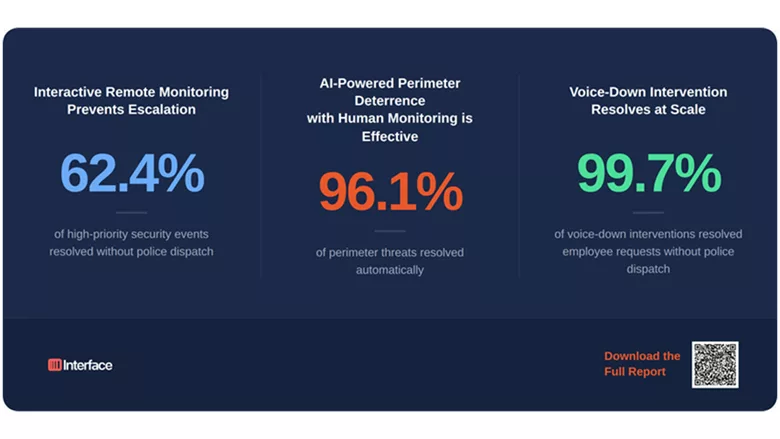
Interactive remote video monitoring reduces escalation. 62.4% of high-priority security events were resolved without police dispatch when interactive remote video monitoring was deployed. Voice-down intervention, where a trained intervention specialist communicates in real time through on-site speakers, resolved 99.7% of employee assistance requests without law enforcement involvement.
#ask-sdm-ec a {
display: inline-flex;
align-items: center;
gap: 10px;
padding: 10px 20px;
font-size: 16px;
font-weight: 600;
color: #348089;
background-color: #fff;
text-decoration: none;
border-radius: 4px;
border: 2px solid #348089;
box-shadow: none;
transition: all 0.25s ease-in-out;
}
#ask-sdm-ec a:hover {
background-color: #348089 !important;
color: #fff !important;
}
#ask-sdm-ec a svg {
width: 18px;
height: 18px;
stroke: currentColor;
stroke-width: 1.8;
fill: none;
stroke-linecap: round;
stroke-linejoin: round;
flex-shrink: 0;
transition: inherit;
}
Looking for quick answers on security topics?
Try Ask SDM, our new smart AI search tool.
Ask SDM →
Video verification eliminates false alarms. 95% of alarm events were identified as false alarms through live video verification and resolved without dispatch.
Employee vulnerability peaks at transitions, not peak hours. Of the 1.1 million employee assistance requests logged in 2025, demand was highest at 10:00 a.m. (97,432 requests) and peaked at 7:00 p.m. (146,672 requests), aligning with store opening and closing times.
Loitering and disturbances have higher rates of escalation. Loitering and disturbances have a consistently high dispatch rate ranging from 65-82%. Both categories peak daily between 6:00 p.m. and 8:00 p.m., the same window as overall incident volume.
The day before a holiday carries more risk than the actual holiday itself. Pre-holiday days averaged 148 incidents versus 138 on actual holidays, representing a 5.5% incident drop on holiday.