

Recent developments in the war on Gaza have shifted from the likelihood of a cease-fire to one in which the war will ramp up significantly – with Israel focused on freeing its hostages and destroying Hamas by seizing the entirety of the Gaza Strip.
Analysts note this decision has not only upset most regional states and Western countries with a vested interest in the area, but also many inside Israel – who are concerned not only how it will resonate internationally for Israel over the long term, but also how it will drive fissures already present within Israeli society.
Analysts added that while this is likely to be the policy in the near term – especially given the de facto approval given to it by President Trump – there are a few aspects which could lead to it either being expanded or contracted.
Political realities in Israel
At the outset, analysts are quick to point out that the for the Far Right in Israel, seizing all the Palestinian territories is something they have always sought. And while Prime Minister Netanyahu has ebbed and flowed with various political realities – usually driven by Washington DC – he has nevertheless supported an aggressive posture over his career.
However, at the current time senior officials in Washington DC, as well as Israel, see Netanyahu is being a difficult political position.
On the one hand, while he maintains a majority via his coalition partners – mostly Far Right – he also is not supported by most Israelis. According to current and former senior Israeli officials – they have no doubt that Netanyahu’s decisions are driven by personal issues vice military strategy. Keeping his coalition in place while also keeping himself and his family out of jail are the two competing aspects driving all recent decision vis-à-vis Gaza, as well as Lebanon and Iran.
Internationally the only issue of any importance to Netanyahu at the present time is President Trump. Trump enjoys strong support in Israel, something Netanyahu does not want/need to have leveraged against him. Therefore, courting the U.S. President and his Administration have been of primary importance over the near term, and are expected to continue to be until the issues related to Netanyahu’s criminal case can be addressed.
For Trump’s part, analysts highlight he has also ebbed and flowed, pushing Netanyahu to accept a cease-fire and allow for humanitarian relief at times, and then supporting a more aggressive prosecution of the war when Hamas become incalcitrant. It is this latter aspect which has been driving the current announcement by Netanyahu that he will pursue a policy to take control over all of Gaza to secure the hostages, while also destroying Hamas.
That said, Netanyahu did not expect the loud criticism he has been receiving from all fronts –in particular from within senior levels of the current/former Israeli government and security establishment. Senior Israeli officials note Netanyahu has been forced to recast his efforts to appear to be more open to having an Arab/Palestinian government in place once Hamas and the hostage issue are resolved.
However, for analysts, the fact that he is not willing to consider a Palestinian Authority (PA)-led government, in any form, preferring to have others involved, as telling. The issue is there are not many others affiliated with either Hamas or the PA at present. This – for analysts – is indicative of plans to leverage elements from the UAE and Qatar – given the active role they have both been playing over the past years with all sides.
What is the real plan for the territories?
Despite statements that there is no desire for Israel to maintain control over all of Gaza indefinitely, analysts are somewhat doubtful. Although they caveat that the timeline for this is much longer than over the coming months or year. Specifically, they assess the plan is for Israel to eventually seize all of the territory and overtime absorb it into Israel.
The areas currently being discussed – Gaza City, the central Gazan camps, and the al-Mawasi, located just north of the Egyptian/Gazan border – all present logistical challenges to the IDF given their size and how imbedded Hamas is via its tunnels and connections with the local community. Given the challenges experienced to date, it is expected a full military campaign in these areas will require much more manpower than expected, as well as likely leading to significant numbers of IDF losses. Given the lack of popular support for this new gambit, analysts are confident it will lead to significant protests in Israel, as well as abroad.
The West Bank
While not discussed much, analysts assess the West Bank will continue to be an active military zone. Analysts point out that while such activities have been addressed periodically since the start of the war, it has not been a regular area of focus except by those intimately involved in the conflict or region.
Analysts view the West Bank situation as a major wild card – not only in the Palestinian/Israeli crisis, but for the region. For what happens in the West Bank has a direct impact on neighboring states – particularly Jordan, Syria, Lebanon, and Iraq.
And while analysts continue to believe Gaza will continue to be the main focal point for activities and discussions, military operations will continue throughout the West Bank.
What is the plan to move Gazans to another location?
President Trump’s declaration that all Gazans would be removed from the region to allow it to be rebuilt continues to resonate as well. And discussions continue around potential regions which could act as a new/future homeland for Palestinians. While Southern Syria had been discussed, the current focus is directed at Africa, i.e. portions of Somalia or possibly Uganda.
For their part, Arab states are working to try to stem the potential for this narrative to resonate, as well as undercut the ability of Netanyahu’s policy to gain control over all Gaza to be actualized.
They are working quietly and not-so-quietly to pressure Hamas to accept Israel’s terms for a cease-fire, i.e. turning over all hostages, giving up their intent to continue to rule, and essentially disband the group.
But for Hamas, as has been highlighted in the past, accepting such an agreement would be akin to it signing its own death warrant. As such, Hamas believes if they can have regional powers interacting with them there is hope – specifically, hope that at least the group’s survival in some form will be accepted.
For Hamas, history is important as the group’s strategy often derives from what has happened in the past. This has been true vis-à-vis its tactic for taking IDF soldiers’ hostages (i.e. deals have previously led to thousands of Palestinians being released for 1 Israeli). This also holds for political issues. Specifically, Hamas leaders point to the model of Fatah and Yasir Arafat moving from the territories to Lebanon then to Tunisia in the 1980s as illustrative of how from the edge of destruction a group – labeled a terrorist organization – can reinvent itself into a major, accepted, legitimate, political player.
What might the road forward look like – this time…
In the near term, analysts expect Netanyahu to pursue his stated objectives of expanding Israel’s presence in Gaza, even to the point of setting up settlements. The immediate goal continues to be to secure the release of living hostages and/or repatriating those killed, as well as continuing to dismantle/destroy Hamas.
The wild card in this will be the U.S.
At present, the Administration is thoroughly focused on Ukraine and Russia – securing an agreement/any agreement to stop the violence. The upcoming meeting between Putin and Trump in Alaska will be a major test of the U.S. President’s ability to either cajole an agreement from Putin or begin exerting an increasing amount of political/economic/military leverage against him.
Analysts view this as less an issue about Ukraine and more about the dynamics between these two leaders. For – they note – neither Trump nor Putin are particularly fond of Zelensky, and both would like to see him move out.
All that said, for Trump gaining wins is key. The recent Armenian/Azerbaijan agreement was one such victory – but one that has not/will not resonate as loudly as a Ukrainian deal. That said, he has made a point of stating his efforts have led to the Administration realizing a peace deal-a-month. These include agreements between Thailand and Cambodia (July), Rwanda and the Democratic Republic of the Congo (June), India and Pakistan (May), and Israel and Iran (June).
As for how this affects the Middle East, until a real agreement is within reach, it will not be a main priority for the Administration.
The successes delineated above have been part of a concerted effort to shift the narrative away from one questioning whether the President has the ability to follow through on his campaign commitments to quickly resolve major international crises – particularly those dealing with Russia/Ukraine and Israel/Gaza.
As for long term planning in the region, analysts point out it is difficult, if not impossible to know how things will trend as Israeli, U.S., Palestinian, Saudi, broader Middle Eastern politics and economic developments all play a role, not to mention China, Russia and Iranian plans. That said, it is assumed for the time being military operations throughout Gaza will ramp up significantly – with Netanyahu highlighting successes, particularly in securing the release of hostages to stem the criticism expected.
Analysts also believe we are likely to see more attempts to put in place a cease-fire by Qatar, European states and Egypt, with U.S. support. However, unless there is a unique way to address Hamas’ survival, they are unlikely to gain much traction unless President Trump ardently supports the effort.
One thing that could force the President’s hand would be a massive humanitarian incident that would be irrefutable, possibly moving Israel as well. But as many senior Israeli officials point out, there does not appear to be any realistic concern by Netanyahu of his government over the massive international price the country is paying by pursuing the present course of action.
What does the future look like for Lebanon – possibly like Palestine: There has been a growing sense of frustration both internally in Lebanon as well as among U.S. leaders over the lack of resolve by Lebanon’s new President Joseph Aoun.
At the beginning of Aoun’s presidency, there was hope he would not only be able to galvanize broad Lebanese support but also be willing to take active steps to sideline/undercut Hizballah – building upon Israel’s military campaign that effectively destroyed most of the group’s leadership.
However, over the past months what has taken place on the ground has been less than what was hoped by those in the West and caused many concerns inside Lebanon.
For those in the West, particularly the U.S., promises of political and economic support led Aoun to reluctantly agree to the U.S.’ goal of disarming Hizballah completely. This was formally adopted by Lebanon’s cabinet on 07 August – endorsing the objectives of a U.S.-backed proposal aimed at securing “state exclusivity on weapon ownership.” As a result, the Lebanese Armed Forces (LAF) were tasked to present a detailed operational plan by 31 August to achieve this goal. However, it has led to backlash across the political spectrum and from the street.
Concerns with this policy include:
- The West/U.S. is concerned Aoun is not willing to earnestly follow through with this policy. While he has made overtures to Hizballah to turnover its weapons, Hizballah’s current leadership continues to be defiant and resistant in these calls.
- Hizballah understands clearly that by turning over its weapons it would lose any power that remains. And this undercuts its broader effort to (1) regain the role, influence and power it had prior to Israel’s military campaign; (2) and to convince Lebanese that the group continue to be as influential as it was.
- It has also taken on a political/constitutional struggle, with Hizballah and its allies invoking Lebanon’s confessional power-sharing agreement. Specifically, Hizballah argues that the decision breaches the charter, an understanding that national decisions must carry broad sectarian consensus, not just constitutional legitimacy. While not codified in law, Hizballah has used this understanding in the past to resist efforts to disarm the group.
The economy continues to present practical problems as well
The economic crisis facing the country continues to play a significant role in not only the day-to-day functioning of Lebanon, but also the sentiment of the people – many who lost their life savings when the banking system collapsed. Seeking financial support from the international community to navigate the country out of this problem has been a major driver for Aoun and his government to embrace the U.S.
However, so far not much has changed. And analysts note there have been many changes in personnel and statements regarding changes coming that would reestablish the country’s economy – not much has come to fruition. And for average citizens the only thing they want to hear is their money will be returned to them. Rumors of partial payouts – 10%-30% or one-time payouts maxed out at $100,000/$250,000 are not seen as workable scenarios, especially for those who lost much more.
In this environment Aoun and his government are starting to be viewed as being fully in America’s pocket – willing to do its bidding but nothing to help the people or to stop Israeli aggression.
Israeli aggression – Is it really something they want to stop?
Continued Israelis attacks on Hizballah weapons caches and presences across the country, along with the IDF’s presence in southern Lebanon, have taken on an interesting dynamic, especially due to the policy of disarming Hizballah.
According to senior Lebanese officials, the country’s leadership has essentially been placed in an impossible situation. Should the country pursue disarming Hizballah with vigor, it would likely gain more financial support from the U.S./West, which would help reestablish the financial/banking sector, but it would likely lead to a civil war. And for Lebanese, the memories of previous civil wars are far too real. As such, this has been weighing heavily on Aoun’s mind and driving his action – or lack thereof.
Interestingly, or some analysts say – ironically – senior Lebanese officials quietly believe it is prudent to let the Israelis continue active operations targeting Hizballah.
This not only addresses the Hizballah problem, but it does it in a way that allows Aoun to blame someone else while reaping the benefits. It also provides the Lebanese President time to try to find a political way to sideline Hizballah from within the system, albeit without leading to another civil war.
Analysts find this ironic as it is the same way the Palestinian leadership has addressed its struggle against Hamas in the West Bank for more than two decades.
While there are several police, security and intelligence organizations in the West Bank reporting to the Palestinian Authority (PA), they are/have been reluctant to fully engage Hamas or other Islamic groups in a real/meaningful fight. While there have been times when they have been more active, at their core, they look to Israel to prosecute these operations. They point to the fact that while they exist as structures of the PA, they are not allowed to operate in any real way due to Israeli control over the cities and towns of the West Bank, and any/all movement between them. Also, there is an inherent fear of reprisals against them and their families should they undertake such operations as the system is a system in name only.
While Israel does not maintain such control over Lebanon, there are similarities in these approaches which analysts believe Lebanon/Aoun will pursue for some time given the realities of its/his own internal political and economic struggles.

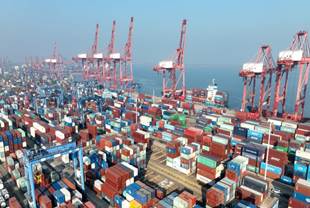
China grows more confident it can weather the storm, looking to expand: Analysts note recent trade data illustrates China has been able to pivot effectively – or at least appears to have – from the tariff threats from the U.S.
According to the July trade data:
- Exports rose by 7.2% y/y, up from 5.9% in June.
- Imports expanded by 4.1% y/y, up from 1.1%.
- China’s trade surplus hit $98.2 billion, up 14.9% y/y – the second-biggest July surplus on record.
Sales of high-value goods drove export growth:
- Semiconductor chip exports surged 29.2% y/y.
- Auto exports jumped 25.5% y/y.
- Machinery and electrical product exports grew 8% y/y
Meanwhile, trade with the U.S. continued to fall:
- Exports to the U.S. fell by 21.7% y/y.
- Imports from the U.S. declined by 18.9% y/y.
As such, analysts noted that while total trade between the U.S. and China dropped 21.7% y/y from April to July, it rose to:
- Africa – surging 25.2% y/y.
- ASEAN – increasing by 9.5% y/y.
- Latin America – up 4.9% y/y.
- The EU – rising 4.5% y/y.
Regardless of whether this trade diversification reflects genuine demand in new markets or merely transshipment schemes to evade U.S. tariffs, the speed of China’s export pivot has been remarkable to analysts. That resilience has reinforced Beijing’s confidence in the country’s ability to weather the trade war.
That said, U.S.- China tensions remain high, with the Administration stepping up efforts to crack down on transshipments. This is expected to create a bumpy environment for the next few months.
However, within this context, President Xi and his team are growing more confident and looking to leverage China’s financial sector to support the country’s industrial transformation.
This was manifest recently when seven government agencies published guidelines on increasing financial support for “New Industrialization.”
(By way of background, “New Industrialization” refers to China’s use of innovation to increase industrial efficiency.)
The document was jointly issued by the:
- Chinese Central Bank (PBoC)
- Finance Ministry (MoF)
- Ministry of Industry and Information Technology (MIIT)
- The National Development and Reform Commission – the State’s macro planning agency (NDRC)
- The National Financial Regulatory Administration (NFRA)
- China’s Securities Regulatory Commission (CSRC)
- The State Administration of Foreign Exchange Foreign (SAFE)
While such statements have been made in the past, analysts view this effort as more significant and illustrative of a shift in approach and policy by China’s leadership.
While the center piece of the effort is to focus on high-end, intelligent, and green development of traditional manufacturing, China is also looking to leverage financial institutions to support mining companies’ efforts to increase reserves of strategic minerals, and expand long-term loans for:
- Digital infrastructure, including 5G.
- The industrial internet.
- Data and computing centers.
And more broadly, analysts note regulators want the financial sector to:
- Enhance the effectiveness of industrial clusters.
- Encourage industrial transfers to less developed western provinces.
- Ensure the health of supply chains.
- Fund innovative start-ups, particularly in hard tech
What analysts see is a change in not only perspective but also approach from this initiative. They note China’s financial system is not designed to support innovative, high-tech development. But it is gradually adapting, with regulators now pushing for it to change faster. They expect ministries and agencies will issue detailed implementation plans in the coming months to put this high-level strategy into practice.