

What to Know:
-
Florida created the hurricane tax holiday in 2005 after the devastating 2004 hurricane season.
-
The state expanded the program to two holiday periods in 2022, creating preparedness reminders at both the start and peak of hurricane season.
-
In 2025, lawmakers replaced the holidays with permanent tax exemptions.
Recommended Videos
For emergency managers, preparedness campaigns often succeed not because they save people money, but because they give people a reason to act before a storm approaches. Since 2005, as part of Florida’s Disaster Preparedness Sales Tax Holidays, the state has on and off designated specific items deemed essential to helping residents prepare for disasters.
Those disasters were primarily hurricanes.
Depending on the year, the tax-free periods occurred once at the beginning of hurricane season or twice, with a second tax holiday added during the historical peak of the season in late August and early September.
For two decades, Florida’s hurricane tax holiday did more than save residents a few dollars on batteries and generators – it generated news coverage, retailer promotions, emergency management campaigns and annual reminders that hurricane season had arrived.
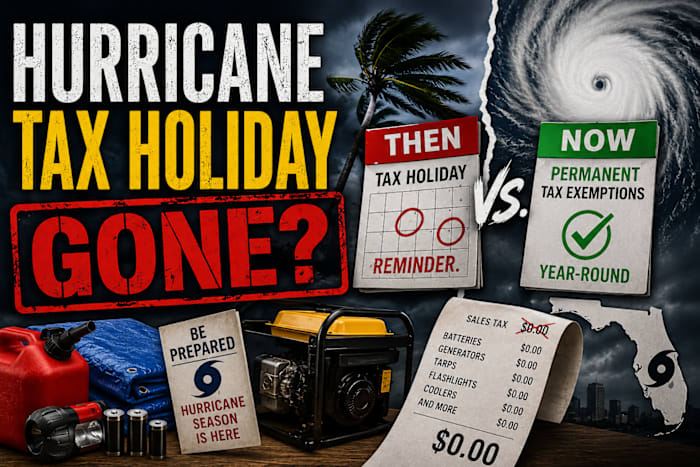
In 2025, things changed as lawmakers replaced the tax-free windows with permanent exemptions on many preparedness items, arguing that disasters can happen at any time. Did Florida’s leaders inadvertently eliminate one of the state’s most visible annual hurricane preparedness reminders?
The history of tax-free holidays
Florida’s Disaster Preparedness Sales Tax Holiday began in 2005, shortly after the devastating 2004 hurricane season, when Charley, Frances, Ivan, and Jeanne struck the state.
The four storms caused an estimated $20 billion in damage and helped shape Florida’s modern approach to hurricane preparedness.
During the 2005 legislative session, State Representative Ron L. Greenstein (D-Coconut Creek) and State Senator Skip Campbell (D-Tamarac) floated the idea of not collecting tax on hurricane essentials for a two-week period. The idea mirrored the state’s tax-free holiday on school supplies, which had been in place since 1998. But like that exemption, it would come at a cost.
A Florida Senate analysis concluded the state would lose $37.8 million in tax revenues on hurricane prep items; municipalities would lose another $7.9 million.
Gov. Jeb Bush signed the combined House and Senate bills into law on May 23, 2005. The holiday, however, wasn’t a permanent fixture. Since 2005, lawmakers repeatedly expanded, shortened, suspended and revived the program:
-
2005-2007: Tax-Free Hurricane Supplies Holiday (12 days)
-
2008-2013: No Tax Free Hurricane Supplies Holiday
-
2014: Tax-Free Hurricane Supplies Holiday (9 days)
-
2015-2016: No Tax Free Hurricane Supplies Holiday
-
2017: Shortened Tax-Free Supplies Holiday (3 days)
-
2018-2020: Tax-Free Hurricane Supplies Holiday (7 days)
-
2021: Tax-Free Hurricane Supplies Holiday (10 days)
-
2022-2024: Tax-Free Supplies Holiday Extended to 2 Periods
-
2025: Tax-Free Hurricane Supplies Holiday Eliminated and Replaced with Permanent Exemptions (Budget was not in place for a June start – budget was not signed into law until June 30)
-
2026: Permanent exemptions stand year-round
What’s Different Today?
Under the old system, Floridians could purchase a broad range of hurricane preparedness items tax-free during designated holiday periods. Under the new system, many preparedness supplies now remain tax-free year-round:
-
Carbon monoxide alarms
-
Fire extinguishers
-
Generators
-
Insect repellent
-
Life jackets
-
Smoke detectors
Some products, however, that were eligible during previous disaster preparedness holidays did not make the transition.
-
Flashlights
-
Portable power banks
-
Reusable ice packs
In other words, Florida did not eliminate tax relief for hurricane preparedness supplies – it changed how and what delivered the relief.
Measuring the Reminder Effect
Whether the tax holidays actually made Floridians more prepared is difficult to measure.
The tax savings themselves were relatively modest. A $30 flashlight would save a shopper less than $2 in state sales tax. A $20 package of batteries would save about $1.20.
But the value of the holiday may have extended beyond the savings. In fact, lawmakers themselves often described the holidays as reminders rather than simply tax breaks. In 2006, State Sen. Carey Baker said, “This legislation is an incentive for Floridians to stock up on supplies, as well as a reminder to prepare for the safety of their families.”
The state appeared to embrace that concept even further in 2022 when lawmakers expanded the program from one annual holiday to two separate tax-free periods. The first coincided with the start of hurricane season and the second occurred during the historical peak of hurricane season. The combined events provided state leaders with another opportunity to promote emergency preparedness and residents with another window to replenish supplies.
Then came 2025.
The change was notable because it came only three years after lawmakers expanded the program to include the two annual tax-free periods. Instead of temporary tax holidays, Florida opted for permanent sales-tax exemptions on many preparedness items.
The rationale was straightforward: disasters can happen at any time, and residents should not have to wait for a designated tax-free window to save money. The change means Floridians can now purchase many preparedness items tax-free year-round. But it also means the state no longer has a recurring event tied to the start or peak of hurricane season.
The result is a tradeoff. Floridians gained year-round tax relief but lost the recurring event that once focused attention on hurricane readiness.
The real thing to focus on: hurricanes don’t care when things are on sale. Florida has provided its residents with an opportunity to save money on preparedness items year-round. It’s up to residents to remember those savings are always in place – not just when meteorologists forecast an approaching storm.