
Chatbots now place orders, code assistants push updates, and autonomous agents comb production databases while you sleep. That speed feels magical, but a single prompt can reroute the workflow and siphon customer data.
Six months ago, the U.K. National Cyber Security Centre warned that prompt-injection flaws in large language models “can’t be patched away like SQL injection.” At the same time, LayerX’s 2025 telemetry showed generative-AI traffic behind 32 percent of confirmed corporate data-leak incidents.
Unsupervised bots are everywhere, and security teams are still catching up. This guide spotlights eight agentic-AI security vendors that add guardrails without slowing your roadmap.
How we built the shortlist, and why the order matters
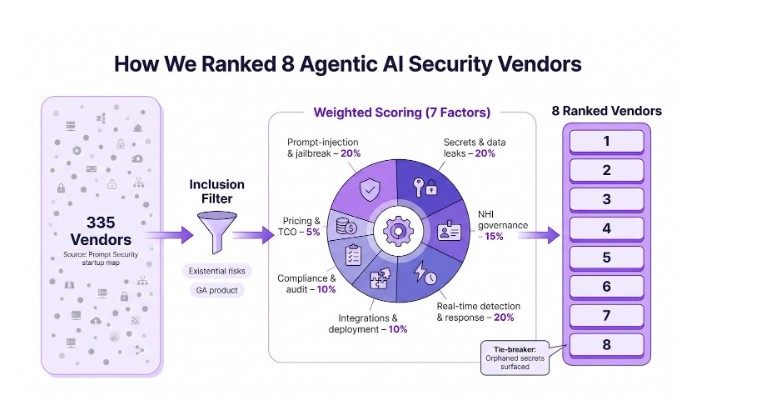
First, we mapped the entire agentic AI security market, identifying 335 vendors in the Prompt Security startup map.
Next, we applied strict inclusion rules. Each company needed a generally available product that addresses at least one existential risk: hostile prompts that redirect an agent or secrets that spill through a chat window. No slideware, no “coming soon,” and nothing confined to model-training labs.
We then scored every qualified vendor across seven enterprise-centric criteria:
-
Prompt-injection and jailbreak defence: 20 percent
-
Secrets and data-leak prevention: 20 percent
-
Non-human-identity governance: 15 percent
-
Real-time detection and response: 20 percent
-
Breadth of integrations and deployment effort: 10 percent
-
Compliance alignment and audit support: 10 percent
-
Pricing transparency and total cost of ownership: 5 percent
Each factor received a binary or 1-to-5 grade, multiplied by its weight. When two vendors tied, the one that also surfaced orphaned secrets ranked higher.
Identity carried weight because, according to Proofpoint, only 14.4 percent of enterprise AI agents have full security and IT approval today. Rogue agents already roam corporate networks, so governance is non-negotiable.
Finally, we compared the math with real-world signals such as Reddit threads, conference demos, and case studies to confirm that paper strengths translate to production value.
The result is a ranked field of eight vendors proven in live environments, not just on analyst slides. We’ll start with the highest scorer and work our way down so you can match capabilities to your own risk profile.
1. Entro Security – the single pane for agents and secrets
Picture every AI agent wearing a name badge and carrying only the keys it truly needs. Entro makes that idea real. Enter Entro—the agentic AI security company whose pledge to “govern every AI agent and secure every action” frames everything it builds. The platform turns that slogan into practice by treating autonomous code as a non-human identity (NHI) and coupling that view with deep secret scanning across repos, CI jobs, and chat logs.
Connect Entro to your cloud pipelines and, according to the product docs, you’ll see an inventory of every service account, token, and API key (more than 1,200 NHI and secret types in total). Idle tokens glow red, orphaned keys are quarantined, and over-privileged agents lose excessive access in minutes.
At runtime, Entro’s NHIDR™ engine builds a baseline and alerts the moment an agent steps outside its lane, such as a finance bot calling an unfamiliar billing API. Because NHIDR watches actions, it doubles as a jailbreak detector; you don’t need to parse every prompt if you can block the forbidden call.
The biggest win is consolidation. Instead of juggling a secrets scanner, an identity vault, and an LLM firewall, security teams get one interface, and early customers report thousands of forgotten tokens surfacing on day one (see Entro Labs case study).
Trade-offs
Entro does not redact PII inside the prompt stream, so you may still want an inline content filter. Pricing is enterprise-only and available after a sales call.
For organizations managing fleets of internal agents, Entro delivers visibility and control in a single step.
2. Palo Alto Networks – extending the SOC perimeter to AI
If your security operations center already runs on Palo Alto’s Cortex platform, you have an AI on-ramp hiding in plain sight. Cortex XSIAM ingests the same audit trails, LLM logs, and SaaS events that point tools parse, then pushes them through the machine-learning pipeline analysts already trust.
The workflow stays familiar: detect an anomaly, correlate context, trigger a response. The data set, however, is broader. Feed in LLM prompts, model outputs, and agent tool calls, and XSIAM’s behavioral analytics flag moves that break historical patterns, such as a support bot exporting an unusual volume of customer records or a GPT helper spinning up cloud instances after hours.
Palo Alto’s advantage is reach.
-
Next-Gen CASB sees employees paste code into ChatGPT.
-
Prisma Cloud records tokens landing in unexpected regions.
-
The firewall tags outbound calls to new AI APIs.
Pipe everything back into Cortex and analysts receive one incident timeline instead of three siloed alerts.
Policy teams also benefit from Palo Alto’s research for the OWASP Agentic AI Top 10, shipped as Threat Prevention content packs, so blocking a known jailbreak sequence feels as routine as adding a new malware signature.
Limits remain: XSIAM will not rewrite prompts or scrub secrets in transit, so you still need an inline firewall for that task. For large enterprises that already license Cortex, broadening SOC visibility to AI with existing tooling is a quick, contractless step forward.
3. Trend Micro Vision One – DLP muscles meet AI street smarts
Trend Micro earned its stripes on endpoint and email defense, and now it points the same sensors at generative AI. The December 2025 Vision One AI Security Package adds “AI security posture” panels beside ransomware and phishing dashboards, letting analysts watch prompt traffic the same way they watch malware beacons.
The upgrade leans on Trend’s established DLP engine. Browser extensions and CASB hooks inspect every keystroke bound for public LLMs, blocking API keys or PII before Enter is pressed. In the data center, Vision One correlates that user-side insight with cloud and endpoint telemetry. If an invoice bot suddenly moves gigabytes of PDFs after a suspicious prompt, you receive one annotated alert, not three disconnected ones.
Detection content stays fresh because Trend’s research team supplies new rules regularly. Their 2025 “vibe-crime” report on AI-enabled fraud produced updated signatures within weeks, proving a legacy vendor can still respond swiftly.
Gaps to note
Vision One does not rewrite or sandbox prompts, and its injection detection relies on anomaly scores rather than deep language parsing.
For organizations that already rely on Trend Micro, activating the AI modules gives your team broad coverage without extra contracts or consoles.
4. Noma Security – a control plane built for the chaos
In July 2025 Noma closed a USD 100 million Series B to give security teams Kubernetes-level observability for AI assets. Open its console and you’ll find an auto-generated inventory of every model, plug-in, and shadow agent across clouds and SaaS, color-coded by risk and tied to the human who spawned it.
Advertisement
Discovery is only step one. You can write plain-language policies such as “This agent never sends PII outside our tenant,” and Noma enforces them inline. A blocked action logs to the audit trail and can ping the workflow’s owner in Slack, turning governance into near-real-time feedback.
What sets Noma apart is its self-driving red-team. The platform continuously launches safe prompt-injection probes against your agents, then shows which attacks slipped past in-app guardrails. That loop turns policy writing into measurable iteration instead of guesswork.
Deployment is heavier than a drop-in SDK. You route agent traffic through Noma’s proxy or run a sidecar and grant read access to cloud logs so it can stitch the full picture. The reward is broad governance: one policy update reaches every agent, no matter which LLM or toolchain sits underneath.
If you’re spinning up dozens of autonomous workflows and worry about drift, Noma offers deep control. Just budget integration time and expect enterprise-tier pricing that matches the coverage you’re buying.
5. Onyx – real-time guardrails for ambitious agent builders
Onyx emerged from a venture studio that crashed several prototypes with runaway agents. The takeaway is simple: the faster you build, the shorter the leash must be. The result is a control plane that sits between your orchestrator and the outside world, evaluating every tool call and data hop in milliseconds.
Setup feels like an API gateway. Register an agent, describe its allowed actions in plain English, and flip on the Guardian toggle. From that moment the agent can still explore, but Guardian blocks unauthorized exports, throttles resource grabs, and logs every denied request for review.
Observability steals the show. Onyx records the full prompt chain, intermediate “thoughts,” and downstream API calls in one timeline. When something suspicious occurs, you can replay the attack frame by frame. A built-in least-privilege analyzer flags excess scopes. Nearly three-quarters of organizations grant agents more access than required, according to a 2026 Cloud Security Alliance study. One-click remediation rewrites the policy so the agent keeps only what it truly needs.
Integration is light enough for a hack-week project: drop the SDK into your LangChain stack, point traffic at Onyx’s proxy, and dashboards appear within minutes. Larger shops can deploy the control plane on-prem for data-sovereignty needs, trading ease for ownership.
If your roadmap involves chained agents making live production changes, Onyx provides the switch-ready confidence to ship quickly without risking a surprise database wipe.
6. Macaw Security – cryptographic trust in one line of code
Sometimes the safest fix is proving every call comes from who it claims to be, and nothing more. Macaw does that by giving each agent, tool, and model its own cryptographic key pair. Swap openai.ChatCompletion for macaw_adapters.SecureOpenAI, and Macaw signs every prompt, response, and tool invocation before writing it to an immutable ledger.
That signature creates a tamper-evident audit trail. Need to know which agent fired a risky SQL delete at 2:03 pm? Check the ledger; the hash ties action to identity without room for dispute.
Access control rides on the same keys. If an agent lacks the correct private key for the finance database, the handshake fails long before any policy engine inspects content. The design enforces least privilege at the protocol layer, so even a successful prompt injection can only push an agent to the edge of its fenced-in sandbox.
Developers gain a three-line integration (import, instantiate, call) while keeping familiar APIs. Security teams receive vendor-agnostic coverage: the cryptographic mesh works with OpenAI today, an in-house model tomorrow, and any new modality later.
Trade-offs
Macaw does not scan for secrets or rewrite malicious input. Pair it with a firewall such as LLM Intercept for content safety. If auditability and non-repudiation top your list, especially in regulated sectors, Macaw delivers cryptographic receipts with minimal lift.
7. LLM Intercept – a firewall that reads the fine print
Some risks live only in the text stream. An employee might paste a customer database into a prompt, or an outsider might slip “ignore previous instructions” into a form. LLM Intercept sits in that stream and inspects every character, every time.
Deploy it as a browser extension, a gateway proxy, or a two-line Python SDK. The engine scans outbound prompts for AWS keys, credit-card formats, or proprietary code and blocks or redacts on the spot. On the return path it hunts for jailbreak signatures and instructions that would push downstream agents outside policy, all in under 100 milliseconds. Security teams get a point-and-click policy builder: mask every 16-digit number plus CVV, or block any prompt over 25 KB. Because Intercept sits inline, it is model agnostic: OpenAI today, Claude tomorrow, a local llama next quarter.
Limitations
The tool does not track agent identities or analyze behavior after the prompt leaves. Pair it with Entro or Onyx for end-to-end coverage. As a first layer to curb secret sprawl, LLM Intercept provides rapid, measurable risk reduction with minimal lift.
8. Stellar Cyber – open XDR that brings AI signals into the fold
Stellar Cyber proves you don’t always need a new logo to spot AI trouble; sometimes you can teach your current XDR new tricks. The platform’s hallmark is data fusion: logs, flows, IDS hits, and SaaS events feed one graph scored by Multi-Layer AI.
Its 2025.4 release added parsers for OpenAI and Anthropic audit logs along with generic LLM gateway APIs. When you route those streams alongside endpoint and network telemetry, the system surfaces correlations that point tools miss. A spike in ChatGPT traffic, for example, is checked against Git pulls or outbound SSH sessions, then stitched into a single incident card.
That holistic view helps lean SOC teams avoid constant console switching. Analysts stay in the same workspace, apply familiar playbooks, and let automation start containment, disabling a compromised Okta session and blocking the suspect API token without hopping tools.
Stellar will not rewrite prompts or tag agent identities out of the box, but its open-integration model accepts alerts from Macaw, Onyx, or LLM Intercept through REST. The platform becomes a central brain that converts specialized findings into a timeline responders can act on.
For organizations that already run Stellar for endpoint, network, and cloud defense, adding the new AI parsers is a low-effort extension. MSSPs with multi-tenant SOCs can surface those detections in existing dashboards and keep service margins intact while offering the AI coverage clients now request.
Feature comparison at a glance
The table below condenses hundreds of pages of docs and demos into one view. A check mark (✓) signals a production-ready capability confirmed in publicly available documentation. Empty cells mean you’ll need another tool or custom rule to close that gap.
| Vendor | Prompt-injection defense | Secret-leak prevention | NHI governance | Real-time detection & response | Integrations | Compliance tooling | Transparent pricing |
|---|---|---|---|---|---|---|---|
| Entro Security | ✓ | ✓ | ✓ | ✓ | ✓ | ✓ | — |
| Palo Alto (Cortex XSIAM) | ✓ | ✓ | ✓ | ✓ | ✓ | ✓ | — |
| Trend Micro Vision One | ✓ | ✓ | — | ✓ | ✓ | ✓ | — |
| Noma Security | ✓ | ✓ | ✓ | ✓ | ✓ | ✓ | — |
| Onyx | ✓ | ✓ | ✓ | ✓ | ✓ | ✓ | — |
| Macaw Security | ✓* | — | ✓ | ✓ | ✓ | ✓ | ✓ |
| LLM Intercept | ✓ | ✓ | — | — | ✓ | — | ✓ |
| Stellar Cyber | — | — | ✓ | ✓ | ✓ | ✓ | — |
Macaw enforces least-privilege cryptographic handshakes that block unauthorized actions; it does not parse prompt text.
Use the table to match tool selection with your highest-priority gaps. If secret sprawl tops the list, start with vendors strong in the second column. If unmanaged agents worry you most, favor rows with checks in the NHI governance column.
Overlap is not waste; it is defense in depth. Aim for broad coverage, not a single-pane wish.
Your decision guide: matching tools to risks, budget, and culture
Before you sign a purchase order, or spin up one more free trial, run this five-point check.
-
Count your surface area. How many autonomous agents run in production? How many employees paste data into public chatbots each week? If you can’t answer, start with a discovery-first platform such as Noma or Entro; visibility is oxygen.
-
Rank the nightmares.
-
Secrets leaking? Begin with LLM Intercept or Trend Micro’s DLP modules.
-
Rogue agents deleting S3 buckets? Prioritize real-time guardrails like Onyx or cryptographic controls from Macaw.
-
-
Match effort to bandwidth.
-
Low lift: Palo Alto and Stellar fit into existing SOC pipelines.
-
Higher lift, deeper control: Noma’s proxy or Onyx’s SDK require engineering time but give granular policy enforcement.
-
-
Test under fire. Stage a red-team prompt that tries to siphon customer data. Keep the tool only if it blocks or alerts in seconds and shows you why.
-
Pressure-check pricing. Ask for transparent tiers—per agent, per prompt, or flat enterprise. Hidden overage fees can turn quick wins into CFO headaches.
Work through these steps and you’ll assemble a stack that secures today’s workflows and scales with tomorrow’s goals without drowning your team in dashboards.