

By Adrian Beck
Recent media reports suggest that there is now another form of pandemic coursing through the retail sector but this one is not driven by a biological virus but instead by ‘customers’ inflicting violence and verbal abuse upon the staff employed to serve them. No doubt many of you will have seen video footage on social media and news websites of retail staff being attacked and abused, often by thieves brazenly stealing large quantities of stock from retail stores. And if I were to say to you that an academic study based upon interviews with nearly 500 retail staff, together with recorded company data, showed that 1 in 9 retail employees had been physically assaulted in the last 12 months, nearly 50% had been verbally abused, and that 66% of all incidents were related to incidents of shop theft, it would not come as a surprise. What may come as a surprise though is that this data comes from a study I completed in 1993 (28 years ago) in the UK for a large apparel company.
All incidents of violence and verbal abuse against retail staff are unacceptable, and my point is not to denigrate the victims currently experiencing these events, my point is that for the retail sector, this is certainly not a new phenomenon – if there is a violence pandemic raging through retailing then it has been doing so for very many years. Questions that immediately spring to mind are why is this the case and perhaps more importantly, what should retailers be doing to help address this issue?
Undoubtedly, the broader criminal justice context has a role to play to a degree, and the debate on felony thresholds in the US may well need to be taken into account in terms of the sheer number of shop theft incidents, but I don’t recall these types of laws being in place in the UK 28 years ago when the staff in my survey were being violently victimised. Equally, debates about the willingness and capacity of the public police to respond to retail crime is also a factor that routinely swirls around this issue, but again, the same debate was very present back in the early 1990s. The reality is that if retailers are waiting for potentially glacial changes in criminal justice legislation or a dramatic increase in public policing budgets to address this issue, then they are, in my view, not taking their responsibilities to their employees seriously – you can only wait for Godot for so long.
Looking back at my 28-year-old report, it is interesting to reflect upon the recommendations made and the extent to which they are still relevant today. In summary, they were:
- Develop a reliable and accessible reporting process to understand the scale and nature of the problem – staff should be persuaded that it is both acceptable and desirable to report incidents.
- Ensure the business has clearly stated and communicated company policies and procedures for dealing with violence – do staff know what they should and should not do?
- Listen to staff – they have accumulated wisdom grounded in experience in their particular environment.
- Carefully review store deployments where a lone worker is employed at higher risk places and times.
- Ensure that store design considers the risks associated with violence against staff – the ‘designing out crime’ philosophy.
- Carry out a review of company policies that are associated with violent incidents – refunds are a good example. How are staff trained and customers informed about the company policy on this issue?
- Build capacity to identify and respond to known offenders – banning orders, exclusions, building case files, sharing information with the police and other retailers.
- Develop a comprehensive staff training programme – help staff to identify warning signs of likely violent confrontation but avoid stoking staff fears.
- Ensure support is available to victims – the ‘how are you?’ questions is often more important than the ‘what happened?’ question.
- Fully assess the range of security options available and whether they are appropriately allocated based upon risk – guards, CCTV, panic alarms etc.
In addition, the report also provided some basic (and to a degree a little dated) advice on how staff may be advised and helped to deal with various types of potentially violent incidents.
Recommendations for Retail Staff Avoiding Violence – 1993
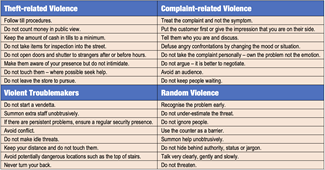
While there is little if any reliable industry data on the overall trend in rates of violent victimization of retail staff, comparing my 1993 data with current concerns would suggest that it remains a persistent and troubling aspect of the retail sector. No staff should be expected to work in an environment where there is a high probability that they may be subject to violence and verbal abuse. It is therefore beholden upon retail organizations to ensure that they not only understand the nature and extent of the problem, but that they also design their stores and processes to minimize the risk and provide retail staff with appropriate support and ultimately protection where it is needed the most. If this is not done, then the pandemic of violence will continue to plague the retail industry.
