By Adrian Beck
Introduction
As part of my recent study for the ECR Retail Loss Group on the use of video technologies in retailing, I spent a considerable amount of time talking to loss prevention executives about how they were thinking about making greater use of a growing list of potential video analytics that were now being offered by a range of vendors. In many respects it would seem, video analytics have become the new ‘frontier’ of loss prevention innovation, with some systems incorporating ‘machine learning’ (ML) and ‘Artificial Intelligence’ (AI) being touted as now offering the capability to identify deviant events even before they have happened – seems like the Minority Report has finally arrived, albeit 19 years late!
Of course, seasoned loss prevention executives will say they have heard it all before, not least with the exaggerated claims of RFID in the early to mid 2000s, when one devotee was suggesting it was going to be ‘as significant a technology as certainly the Internet and possibly the computer itself’. I think we all know how that worked out!
But, there have undoubtedly been significant changes in the scope and capabilities of video analytics – computing power has grown dramatically, prices have dropped considerably, and connectivity is now becoming more widespread and accessible. It was interesting to begin to understand how it was being applied, what benefits it might be bringing and to understand some of the challenges of making it work in the often-complex environments found in retailing.
Benefits and Recurring Challenges
What the research found was that the effectiveness and ranging value of video analytics within retailing was impacted by two interrelated factors: the clarity of what problem it was intended to resolve, and the relative environmental complexity within which it was to be used. These two factors then influenced the extent to which video analytical systems were able to consistently and reliably deliver True Positives – actual events that a retailer is interested in knowing about, as opposed to False Positives (events that are not actually taking place but generate an alert) and indeed False Negatives (not alerting when a genuine event is taking place). In addition, the research identified a third unwanted outcome from video analytics – Overload Positives, where a system is configured in such a way as to generate an enormous amount of what may or may not be True Positives, but the volume of alerts simply overwhelms any capability in place to interpret and respond to the identified events.
The research found examples of various types of video analytics that could be positioned within this Clarity/Complexity matrix. For instance, at one end of the extreme, video analytics designed to alert when an intruder was trying to enter a building were generally found to be highly reliable and robust – the event is clearly definable (an unauthorised person trying to enter a building) and the environment is typically uncomplicated (often the back of a building at night where there should not be any persons present).
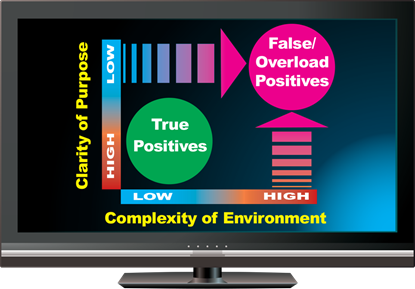
At the other extreme, trying to identify a store thief while they are picking product within a store aisle – how do you decide what theft behaviour looks like in the aisle and how do you differentiate between normal shopping behaviours and theft-like activities, especially as self-scan options become more varied and available? Retailers trialing the latter analytic found a very high level of False and Overload Positives – lots of genuine shoppers exhibiting misinterpreted theft-like behaviours, which in turn caused store guards tasked with responding to the alerts to become largely unresponsive due to high levels of alarm skepticism.
The research also found evidence of what some respondents called the ‘distraction effect’ of some video analytical systems. Unlike standard video technologies, which very often are a plug in and forget technology, video analytics need to be carefully and frequently configured to the environment within which they will be used. Factors such as lighting and changes in layout can have a dramatic and adverse effect upon the ability of video analytics to deliver their intended purpose. This inevitably takes time and cost – one respondent eloquently summarised their experience: It [the video analytic] is down as one of the biggest distractions we ever had. It was a distraction from what we were trying to do. When the supplier showed it in trial mode it was all great, but when you are responsible for setting it up away from the trial environment, it’s a different story. We found the analytics were too unreliable – they were giving too many false alarms. The configuration was too complicated and context specific.
Moving Forward on Video Analytics
It is of course easy to be beguiled by the ‘new’, to resolve that the appliance of science is the answer to all modern problems. Certainly, the ECR research identified examples of where the use of video analytics offered by far and away the best way to address some of the problems retailers face. But it is important that prospective users always undertake a careful review to ensure that any proposed intervention is the most applicable to address the problem under consideration. With video analytics, the potential is real, but retailers need to ensure they have a clear appreciation of the problem they would like it to resolve and the potential impact the environment within which it will operate will have upon its capability to deliver.