

GUEST OPINION: Despite billions invested in enterprise AI, many organisations still struggle to move beyond experimentation and deploy AI at scale. The challenge is rarely the algorithms themselves, but the data infrastructure, governance frameworks, and organisational alignment required for enterprise deployment.
The AI adoption paradox
AI has moved from experimental technology to a boardroom priority. Yet results remain uneven. McKinsey’s latest global AI survey shows that 88% of organisations use AI in at least one business function, but only about one-third have scaled it across the enterprise. Many remain stuck in experimentation without achieving sustained operational impact.
AI investment continues to grow, yet large-scale adoption remains limited. The barriers are usually organisational, infrastructural, and strategic rather than technical.

The enterprise AI pilot trap
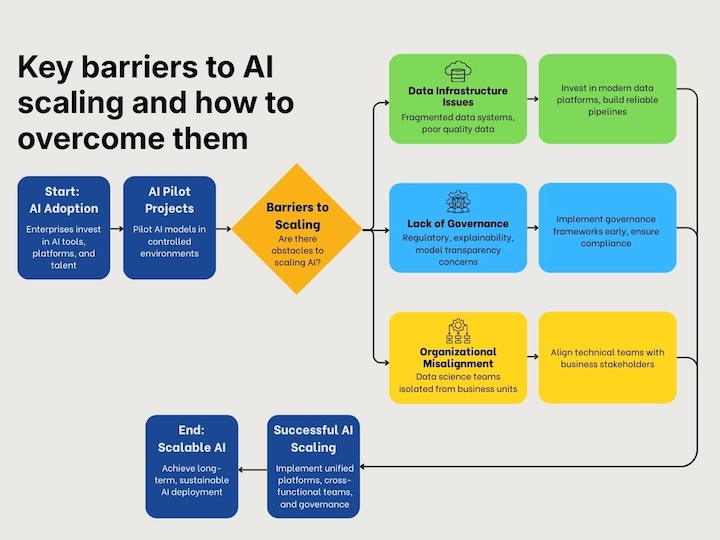
A common pattern in enterprise AI initiatives is the proliferation of pilot projects. Data science teams build promising prototypes that perform well in controlled environments but rarely reach production.
Several factors explain this gap. In many organisations, AI initiatives are led by data science teams operating separately from core IT and business units. As a result, experimental models are rarely designed to integrate with core enterprise systems.
Another challenge is unclear business value. When AI projects begin as technology experiments rather than solutions to operational problems, executives struggle to justify scaling them. Without alignment between technical teams and business stakeholders, many pilots stall before deployment.
Data infrastructure is still the biggest barrier
Enterprise data environments remain fragmented across legacy systems, departmental databases, and disconnected cloud platforms. Poor data quality, weak governance, and limited real-time pipelines make it difficult to deliver reliable data to AI systems at scale.
Gartner estimates that poor data quality costs organisations an average of $12.9M annually, highlighting the impact of weak data foundations on analytics initiatives.
Many enterprises, therefore, rely on experienced technology consulting partners to modernise their data infrastructure and prepare their systems for large-scale AI deployment. This typically involves consolidating data sources, building modern pipelines, and implementing governance frameworks that ensure reliability across the organisation. Without these foundations, even the most advanced AI models struggle to deliver consistent value.
Governance and compliance are becoming critical
As AI systems move closer to operational decision-making, enterprises must address governance challenges such as explainability, bias, model transparency, and regulatory accountability. In sectors like finance, healthcare, and telecommunications, these concerns can significantly slow AI deployment.
The regulatory landscape is also evolving. Initiatives such as the European Union’s AI Act and emerging governance guidelines in the United States and Asia are pushing enterprises to rethink how AI systems are developed, tested, and monitored.
Without clear governance frameworks, many organisations remain cautious about deploying AI systems that could introduce regulatory or reputational risks.
The talent and strategy gap
Another persistent challenge is aligning AI capabilities with business strategy.
Many organisations have invested in data scientists and machine learning engineers, yet technical talent alone does not guarantee successful AI deployment. What is often missing is a clear enterprise strategy that connects AI initiatives with operational priorities and measurable outcomes.
Bridging this gap requires collaboration across IT, data teams, and business leadership. Organisations increasingly work with specialised firms acting as an AI & Blockchain innovation partner to translate emerging technologies into practical enterprise use cases and guide large-scale integration.
What successful enterprises do differently
Despite these challenges, some organisations are successfully scaling AI by focusing on the foundations required for long-term deployment.
First, they invest in strong data architecture, prioritising unified platforms, governance models, and reliable pipelines that support real-time analytics.
Second, they build cross-functional teams that bring together data scientists, engineers, and business leaders, ensuring AI initiatives remain aligned with operational needs and measurable outcomes.
Third, they implement governance frameworks early, embedding responsible AI practices, model monitoring, and regulatory compliance into development workflows.
http://itwire.com/guest-articles/guest-opinion/why-enterprise-ai-adoption-still-fails-to-scale.html