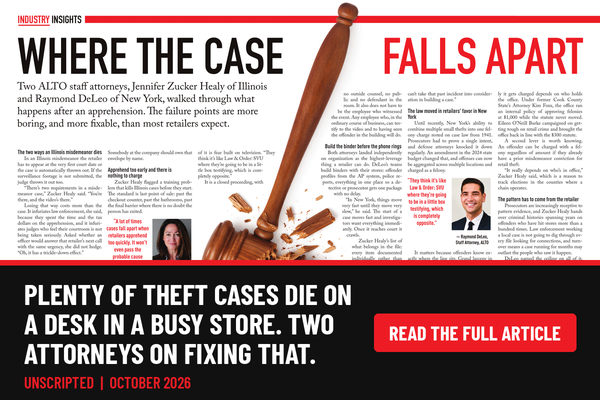
Two ALTO staff attorneys, Jennifer Zucker Healy of Illinois and Raymond DeLeo of New York, walked through what happens after an apprehension. The failure points are more boring, and more fixable, than most retailers expect.
The two ways an Illinois misdemeanor dies
In an Illinois misdemeanor the retailer has to appear at the very first court date or the case is automatically thrown out. If the surveillance footage is not submitted, the judge throws it out too.
“There’s two requirements in a misdemeanor case,” Zucker Healy said. “You’re there, and the video’s there.”
Losing that way costs more than the case. It infuriates law enforcement, she said, because they spent the time and the tax dollars on the apprehension, and it infuriates judges who feel their courtroom is not being taken seriously. Asked whether an officer would answer that retailer’s next call with the same urgency, she did not hedge. “Oh, it has a trickle-down effect.”
In New York, the case dies on a desk
New York does not require a witness at a misdemeanor appearance. The retailer signs a supporting deposition describing what happened, sends it back to the prosecutor, and the case proceeds. Easier, until it fails.
“It gets mailed to a store,” DeLeo said. “A part-time employee receives it or just kind of throws it on a desk, and no one ever gets back to that prosecutor. So now a misdemeanor case with no supporting deposition signed, it has to be thrown out. That’s what the law says.”
A case dies because a piece of paper landed on the wrong desk in a busy store. Somebody at the company should own that envelope by name.
Apprehend too early and there is nothing to charge
Zucker Healy flagged a training problem that kills Illinois cases before they start. The standard is last point of sale: past the checkout counter, past the bathrooms, past the final barrier where there is no doubt the person has exited.
“A lot of times cases fall apart when retailers apprehend too quickly. It won’t even pass the probable cause hearing, which is not a huge threshold to pass.”
Grand jury is not what store teams think it is
New York felonies require testimony, and DeLeo says that is where the biggest breakdown happens on serious cases. Most of it is fear built on television.
“They think it’s like Law & Order: SVU where they’re going to be in a little box testifying, which is completely opposite.”
It is a closed proceeding, with no outside counsel, no public and no defendant in the room. It also does not have to be the employee who witnessed the event. Any employee who, in the ordinary course of business, can testify to the video and to having seen the offender in the building will do.
Build the binder before the phone rings
Both attorneys landed independently on organization as the highest-leverage thing a retailer can do. DeLeo’s teams build binders with their stores: offender profiles from the AP system, police reports, everything in one place so a detective or prosecutor gets one package with no delay.
“In New York, things move very fast until they move very slow,” he said. The start of a case moves fast and investigators want everything immediately. Once it reaches court it crawls.
Zucker Healy’s list of what belongs in the file: every item documented individually rather than as miscellaneous merchandise, photographs, receipts showing retail value, preserved footage, the identified employee witness, and a police report for every incident, including the ones that feel too small to bother with.
Retention windows matter here. Thirty days sounds generous until a case surfaces in week six.
The police report is the piece most retailers skip. “If you don’t have a police report when he’s finally apprehended, the police really can’t take that past incident into consideration in building a case.”
The law moved in retailers’ favor in New York
Until recently, New York’s ability to combine multiple small thefts into one felony charge rested on case law from 1941. Prosecutors had to prove a single intent, and defense attorneys knocked it down regularly. An amendment in the 2024 state budget changed that, and offenses can now be aggregated across multiple locations and charged as a felony.
It matters because offenders know exactly where the line sits. Grand larceny in New York starts at $1,000, so they take $999 and come back tomorrow.
“Now prosecutors are able to see that pattern, see that common scheme or plan, and say that this person comes in every day. This is their motive. This is their plan,” DeLeo said.
He has watched it work: one docket number carrying eight or nine counts of petit larceny plus a grand larceny, indicted at $6,000 instead of $1,000.
In Illinois, the number depends on the election
Illinois makes retail theft a felony over $300. That is the statute. How aggressively it gets charged depends on who holds the office.
Under former Cook County State’s Attorney Kim Foxx, the office ran an internal policy of approving felonies at $1,000 while the statute never moved. Eileen O’Neill Burke campaigned on getting tough on retail crime and brought the office back in line with the $300 statute.
A second lever is worth knowing. An offender can be charged with a felony regardless of amount if they already have a prior misdemeanor conviction for retail theft.
“It really depends on who’s in office,” Zucker Healy said, which is a reason to track elections in the counties where a chain operates.
The pattern has to come from the retailer
Prosecutors are increasingly receptive to pattern evidence, and Zucker Healy hands over criminal histories spanning years on offenders who have hit stores more than a hundred times.
Law enforcement working a local case is not going to dig through every file looking for connections, and turnover means a case running for months may outlast the people who saw it happen.
DeLeo named the ceiling on all of it. “Once it leaves the US, it’s very hard to track where the clothing goes.”
Neither attorney made any of this sound easy. Both made the difference between a case that survives and one that does not sound like whether somebody kept good records.
Read more in UNSCRIPTED
Want more conversations, like “Where the Case Falls Apart,” that go beyond the usual industry talking points? Dive into UNSCRIPTED for original stories, candid perspectives, and insights from the people shaping the future of loss prevention. Check it out Here.