

There is a question haunting the enterprise AI conversation that few people seem willing to ask out loud: if artificial intelligence is supposed to be transformative, why are so many AI projects failing to deliver real value?
Forrester has a prediction for 2026 that cuts to the heart of the matter. The analyst firm believes that process intelligence will rescue – not merely improve, but rescue – thirty percent of all failed AI projects. That is a staggering claim, but after a wide-ranging conversation with Rudy Kuhn, Evangelist at Celonis, it is one that starts to feel not only plausible but obvious.
Kuhn is not your typical enterprise software evangelist. Born in the Czech Republic during the communist era, he and his family escaped the Iron Curtain via Yugoslavia in 1980, arriving in Germany as refugees. A career that began digitizing manual processes at IBM eventually led him to co-found ProcessGold, a process mining pioneer he sold to UiPath in 2019. Today, after a circuitous journey that saw him go from Celonis’s earliest implementation partner to self-described “public enemy number one” and back again, he sits at the centre of one of enterprise technology’s most consequential conversations.
The video interview on which this article is based is embedded immediately below, after which the article continues – please read on!
[embedded content]
From Spaghetti Monsters to Living Digital Twins
The concept of process mining, as Kuhn explains it, is deceptively simple. Every digital activity in a business – creating a purchase order, approving an invoice, shipping a product – leaves behind a digital footprint. Process mining extracts that data from enterprise systems and reconstructs the actual workflows as they truly occur, not as they were designed on a whiteboard.
The result is often what Kuhn affectionately calls “the spaghetti monster”: a chaotic visualisation of every variation, exception, and detour that real processes take. It is messy, sometimes alarming, but it is the truth. And truth, in enterprise operations, has been in remarkably short supply.
“You can ask people, ‘Why does the process look like this?’ instead of asking, ‘How does it look?’ Believe me, there’s a completely different discussion you will have.”
— Rudy Kuhn, Evangelist, Celonis
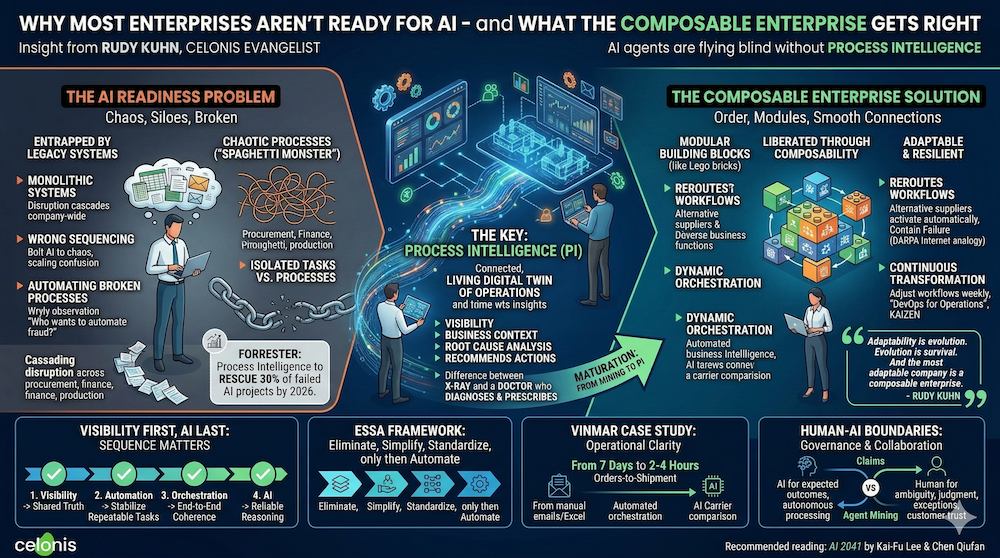
But the field has evolved. Process mining has matured into what is now called process intelligence, and the distinction matters. Where mining provided visibility, intelligence adds business context, identifies root causes, predicts outcomes, and increasingly recommends or triggers actions. It is the difference between an X-ray and a doctor who can both diagnose the problem and prescribe the treatment.
The ultimate expression of this is what Celonis describes as a living digital twin of operations: a real-time, connected representation of how a business actually functions, capable of simulation, intervention, and continuous optimisation. When a segregation-of-duty violation occurs in an invoice approval process, for instance, the system can immediately apply a payment block in the ERP system and route the case to a human reviewer – all before the cheque is cut.
Composability: The Architecture of Survival
In January 2026, Kuhn wrote an article for Diginomica titled “Most Enterprises Aren’t Ready for AI. What’s Needed Is Composability.” It is a word that rarely appears in the breathless discourse around artificial intelligence, and that is precisely the problem.
A composable enterprise, as Kuhn defines it, is one in which business capabilities become modular building blocks – like Lego bricks that can be combined, replaced, and orchestrated without breaking the whole structure. This is fundamentally different from simply having a modern tech stack. Many companies already have cloud platforms, APIs, and sophisticated software, but their processes remain trapped inside monolithic systems and siloed applications.
“Adaptability is evolution. Evolution is survival. And the most adaptable company is a composable enterprise.”
The implications are profound. In a monolithic setup, a single supplier disruption can cascade through procurement, finance, production planning, and customer delivery simultaneously. The entire machine grinds to a halt. In a composable architecture, orchestration reroutes workflows dynamically: alternative suppliers activate automatically, approval paths adjust, and customers are informed proactively. The failure is contained locally rather than becoming a company-wide crisis.
The analogy that comes to mind is the original design philosophy of the internet itself. DARPA built a network that could route around damage, ensuring that the destruction of any single node would not bring down the system. Composable enterprises operate on the same principle, applied to business operations.
But Kuhn is emphatic that composability is not just an IT architecture pattern. Culture matters. Governance matters. Leadership must accept transparency. As he puts it, process intelligence removes comfortable assumptions – and not every organisation is ready for that. He recalls approaching companies in the past where middle managers openly told him they could not be the ones to introduce this level of transparency into their organisations for fear of the political consequences.
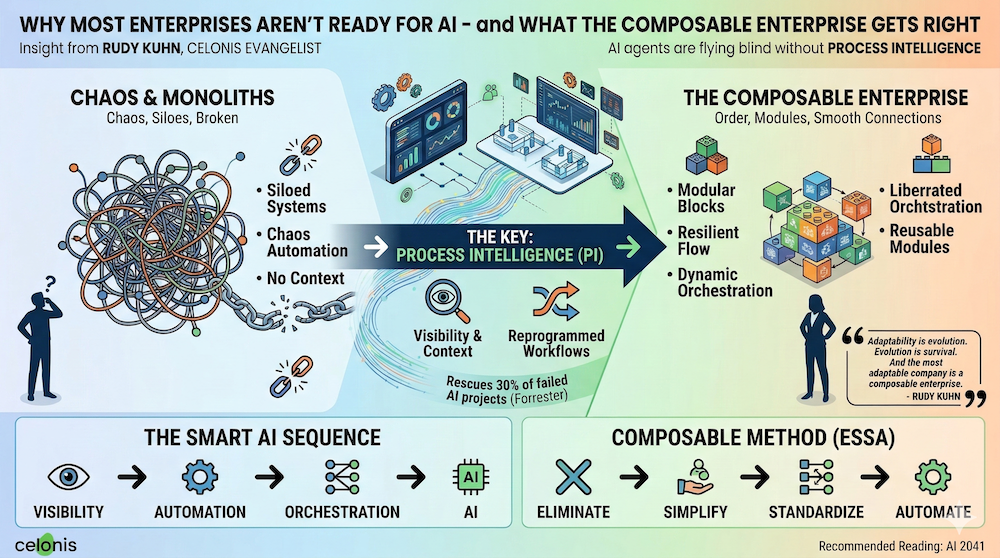
This infographic created by Gemini Nano Banana 2 – the article contines below, please read on!
Visibility First, AI Last: Why Sequencing Matters
Perhaps Kuhn’s most provocative argument is about sequencing. He advocates a specific order of operations: visibility first, then automation, then orchestration, and only then AI. It runs counter to the prevailing instinct of many enterprises, which are rushing to bolt AI onto broken processes in the hope that intelligence will compensate for chaos.
“If you hire the most intelligent person in the world, straight from university with no experience – you wouldn’t make them CEO from day one. They’re intelligent, but not smart. AI is the same.”
The logic is compelling. AI amplifies whatever environment you give it. If processes are broken or inconsistent, AI scales confusion faster. Visibility creates a shared truth about how work actually happens. Automation stabilises repeatable, rule-based tasks. Orchestration – which Kuhn likens to a conductor in front of an orchestra – connects bots, systems, APIs, and people across boundaries to create end-to-end coherence. Only then does AI have something reliable to reason about.
Kuhn draws a sharp distinction between task automation and process automation that many vendors blur. Copying data from an Excel sheet into an SAP form may be a repetitive activity worth automating, but it is not a process – it is a task. True process orchestration operates at the level of purchase-to-pay or order-to-cash, connecting every step end to end.
He also introduces a framework he calls ESSA: eliminate, simplify, standardise, and only then automate. It is a corrective to the impulse that reaches for robotic process automation as a first resort. As he wryly observes: “Who wants to automate fraud?” If a process contains errors, inefficiencies, or compliance violations, automating it simply encodes those problems at machine speed.
Where Humans Stay – and Why That Matters
The question of human-AI boundaries is one that Kuhn navigates with nuance and a healthy scepticism of fully autonomous operations. He cites a German insurance company that uses AI to process all claims. When AI approves a claim, it is paid without human review – the company accepts that one or two percent may be incorrect, because the efficiency savings dwarf the cost of those errors. But when AI flags a claim as suspicious and recommends non-payment, the case is immediately routed to human experts for careful review.
The pattern is elegant: let AI handle the expected outcomes autonomously, but ensure human judgment governs exceptions, ambiguity, and any decision that could damage customer trust or the company’s reputation. It is a model that acknowledges both the power and the limitations of current AI systems.
“The standard, the boring, the repetitive work and rule-based decisions will be made by AI. Humans will stay where judgment, ethics, ambiguity, or customer trust really matters.”
This is where Celonis’s concept of “agent mining” becomes particularly relevant. Just as process mining observes and reconstructs human workflows from system data, agent mining applies the same technology to monitor what AI agents are doing within business processes. It provides the transparency layer that makes agentic AI enterprise-ready rather than experimental. Without it, deploying autonomous agents that decide, act, approve, and change data is, in Kuhn’s assessment, “quite risky.”
From Seven Days to Four Hours: A Case Study in Operational Clarity
The theoretical arguments for process intelligence find concrete validation in real-world deployments. Kuhn describes the case of Vinmar, a multi-billion-dollar chemicals shipping company based in Texas, where process intelligence revealed a massive hidden inefficiency.
Customer orders were taking seven days to progress from receipt to shipment. The reason was invisible to management but immediately obvious once the process was mapped: every order required staff to manually contact carriers for tenders, wait for responses, compile the results in spreadsheets, compare options, select a carrier, and then individually notify the carrier, customer, and warehouse. The entire chain was held together by emails and Excel – functional, but painfully slow.
The solution was an orchestration layer that automated the entire carrier selection workflow. When an order arrived, an HTML form was generated automatically and carriers received email notifications with a link to submit their tenders within a defined window. After the deadline, an AI system compared the responses, selected the optimal carrier, and triggered notifications to all parties. The result: what had taken seven days was now accomplished in two to four hours.
It was so transformative that Vinmar’s CEO personally appeared at Celonis’s Celosphere conference to discuss the impact – an unusual level of executive endorsement that speaks to the magnitude of the operational improvement.
This infographic created by Gemini Nano Banana 2 – the article contines below, please read on!
Continuous Transformation: DevOps for Operations
Traditional enterprise transformation follows a familiar and often painful pattern: a multi-year program is launched, the organisation freezes while redesign happens, and by the time the transformation is complete, the market has moved on. Kuhn argues that composability makes transformation continuous rather than episodic.
The analogy he draws is to software DevOps – the practice of releasing improvements incrementally rather than in monolithic deployments. Applied to operations, this means teams monitoring processes constantly and adjusting workflows weekly rather than every five years. Because the underlying capabilities are modular, change becomes routine rather than disruptive.
Kuhn also invokes the Japanese concept of kaizen – continuous improvement through small, steady changes – as a philosophical touchstone. Evolution, he notes repeatedly, does not happen with a big bang. It happens step by step, continuously, until you end up with something fundamentally different.
The Five-Year Horizon: Self-Steering, Not Self-Driving
Looking ahead to approximately 2030, Kuhn envisions organisations moving toward what he calls self-steering and self-optimising operations – though he is careful to distinguish this from fully autonomous enterprises, a concept he has written about but does not believe will or should become reality.
Certain functions, he suggests, lend themselves to near-complete automation. Accounting, for instance, is heavily determined by law and regulation, making much of the work rule-based and therefore ideal for AI. He foresees a future of “autonomous accounting” where only the five percent of exception cases require human expertise.
But the competitive advantage of the future, Kuhn argues, will not be who has AI. It will be who understands their operations well enough for AI to act safely and effectively within them. This is the core thesis of Celonis’s positioning: there is no enterprise AI without process intelligence, or as the company’s tagline puts it, no artificial intelligence without PI.
“The competitive advantage will not be who has AI. It will be who understands their operations well enough for AI to act safely.”
The Human Element: Why Culture Eats Architecture for Breakfast
Throughout our conversation, Kuhn returns to a theme that transcends technology: the human dimension of transformation. Process intelligence removes comfortable assumptions, and not everyone welcomes that. The data can prove you right or wrong, and some organisations are not culturally prepared for that level of transparency.
He invokes a famous aphorism: “Without data, you are just another person with an opinion.” If organisations treat composability as merely another IT architecture trend, they will fail. If they treat it as operational clarity combined with accountability, it becomes transformative.
For some people, of course, the data vindicates what they have been saying all along. As Kuhn notes, the most common reaction to a process mining engagement is not surprise at the findings, but surprise at the scale. People knew there were problems; they just could not prove it. Now they can.
The Bottom Line
We are now well into the third year of the current AI revolution, and the gap between AI hype and AI value continues to widen for most enterprises. The prevailing narrative focuses on model capabilities, agent frameworks, and the race toward artificial general intelligence. What Kuhn and Celonis are arguing – persuasively, and with growing analyst support – is that the real bottleneck is not intelligence at all. It is understanding.
Enterprises cannot meaningfully deploy AI into processes they do not understand, cannot observe, and have never properly mapped. They cannot build composable, adaptive organisations on top of monolithic systems glued together by Excel spreadsheets and human middleware. And they cannot achieve continuous transformation through episodic, multi-year programs that are obsolete before they finish.
Process intelligence offers a different path: one that starts with seeing reality as it is, builds modular capabilities around that truth, and creates the operational foundation on which AI can genuinely deliver value. It is less glamorous than the promise of sentient machines, but it may be the thing that actually makes AI work in the real world.
As Kuhn puts it with a smile: “When processes work, everything works. People thrive, value is created, and Monday sucks a little less.”
It is hard to argue with that.
+++
As you’ll see in the video interview, Rudy Kuhn recommends reading: AI 2041 by Kai-Fu Lee and Chen Qiufan, as an accessible guide to the long-term implications of artificial intelligence.
[embedded content]