
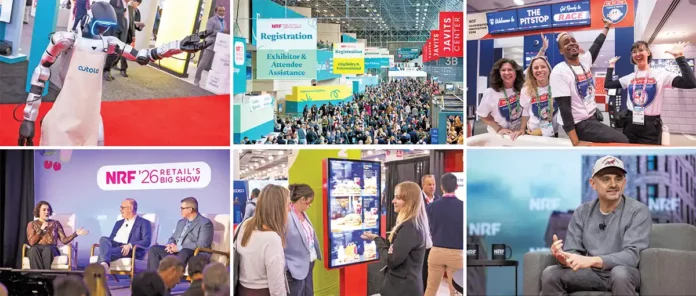
Last month, the annual National Retail Federation Retail’s Big Show filled NYC’s Javits Center with global retailers, technology providers, and brand leaders focused on what comes next for commerce. While the show has long been considered the epicenter of retail innovation, its impact on the restaurant and foodservice industry is now unmistakable. Many of the tools and strategies shaping foodservice over the next decade are being introduced, tested, and validated first on the NRF show floor.
The line between retail and foodservice continues to blur. Restaurants now operate in an environment defined by digital ordering, loyalty ecosystems, fulfillment logistics, and data-driven personalization. NRF matters because it brings together the companies building those systems and the operators already using them at scale. For foodservice leaders navigating labor shortages, margin pressure, and rising guest expectations, the event has become a practical research environment rather than a theoretical one.
Among key show sessions were, Chris Padilla of Dine Brands and Petra Schindler-Carter of Amazon Web Services making the case that customer experience now defines competitive advantage. With more choices than ever, speed and quality matter. They shared how Dine Brands rebuilt technical support across it IHOP and Applebee’s and Fuzzy’s franchises are using streamlined, intelligent assistance, cutting ticket resolution times by 34% and shrinking backlogs. The discussion focused on practical, data-driven approaches retailers and restaurant brands can use to improve service consistency, strengthen franchise operations, and turn better experiences into loyalty and long-term growth.
That scale is exactly what makes the show valuable for foodservice. Retail’s Big Show once again attracted the platform providers behind AI, automation, payments, logistics, and workforce tools that increasingly define restaurant operations. NRF’s Susan Newman added, “It’s the one event that’s bringing retailers together from around the globe, along with solution providers that are showing the next gen iteration of technology. It’s where retailers determine what they’re investing in, what their retail operation is going to be looking like for the years to come.”
Those investment decisions now directly influence restaurants. Self-ordering, predictive staffing, dynamic pricing, and robotics are no longer experimental. They are already operational in retail environments that face many of the same pressures as foodservice. The show floor reflected that reality, especially as consumer behavior shifts due to factors like GLP-1 weight-loss drug adoption and more active lifestyles, which are changing how often people eat out, what they order, and how value is defined.
NRF 2026: Retail’s Big Show keynoter Gary Vaynerchuk emphasized how dramatically social media strategy has changed. “We’re looking at a world where creative is measurable. The greatest thing about social media right now is that the AI algorithms as written are based on relevance.” Success on social media is no longer measured by number of followers but on the popularity and relevance of individual posts.”
The Foodservice Innovation Zone has become one of the most important bridges between retail and hospitality at the event. Rob Grimes, founder and CEO of the International Food and Beverage Technology Association, said, “This sounds like a commercial, but I was an attendee first before we ever were partnering on anything. And that is actually what led to the whole concept of really marrying foodservice and retail together because this is the largest single technology event in our industry across hospitality, foodservice, and retail across the board globally and now duplicated over in Asia and Europe. So, it was a natural place to be.”
Grimes noted that the crossover between industries is accelerating. “What we see is there’s so much foodservice crossover, and we’re not talking about retail food like grocery store because that certainly was the early part of it when we talked about takeout foods and things like that. But it’s actually retailers putting foodservice in or just creating their own foodservice brands,” he said.
For restaurant and foodservice operators, NRF provides a clearer lens on technology strategy. Developing an approach to next-generation tech starts with defining the guest experience a brand wants to protect or improve. Some operators will commit to face-to-face hospitality, using technology to remove friction while keeping human interaction front and center. Others will replace front-of-house or back-of-house functions with automation, robotics, and avatar-based ordering to stabilize labor and improve consistency. Most will adopt a hybrid model that balances efficiency with hospitality.
NRF is vital in that decision-making process because it allows operators to evaluate solutions in context. Rather than seeing isolated demos, attendees can compare providers, understand integration challenges, and hear directly from enterprise users. Grimes outlined that perspective clearly when he said, “The operator is exactly the one who should be seeing this, as well as the technologist, because there’s so much crossover between the different industries. “You’ll see technologies at this event that rarely appear at traditional foodservice industry shows. You’re talking about access to Microsoft, IBM, Oracle, Salesforce, SAP, Google, Shopify, and AWS at the NRF Show.”
As foodservice adapts to shifting consumer health behaviors, digital expectations, and economic pressure, Retail’s Big Show has become less about inspiration and more about due diligence. It is where operators can vet cost-effective solutions, assess long-term partners, and understand what has already been proven at scale. Grimes concluded, “One thing that we’ve brought to life this year as part of the Foodservice Innovation Zone was The Pit Stop, where attendees experienced the four main points-of-service found within foodservice operations today that easily fit also into retail.”
Restaurant operators, foodservice leaders, and distributors looking to prepare for what comes next can reach out directly to the National Retail Federation for information on attending the 2027 Retail’s Big Show in New York City, where registration details and planning resources will be made available as the event approaches.