
President Trump’s meeting with Russian President Putin in Alaska on 16 August was full of expectation and hope. Hope by many that Putin accepted the invitation aware not only that he would be expected to accept terms for peace in Ukraine, but also that he would do so willingly.
That said, as the meeting came together, expectations from the U.S. side moderated significantly.
Analysts note this was more out of concern that the failed expectation of the Summit realizing an agreement would not only lead to the meetings being viewed as a failure, but also that it could jeopardize subsequent steps while also damaging the President’s broader effort to facilitate peace deals in other areas of the world.
In this context, analysts explained that the success of the Summit became more nuanced than a black and white agreement.
Rather, success became measured by the White House in terms of (1) keeping the process moving, (2) not allowing the lack of an agreement to be viewed as a failure at this point, and (3) making Ukraine/Zelensky as the determinants of success/failure – i.e. will he engage in a diplomatic/negotiation with Putin to realize peace with both sides needing to be flexible.
For the U.S.
What became quite clear in the lead up to the summit was the fact that while Putin would be willing to speak clearly and frankly about what he/Russia wants/needs/requires for a peace agreement, it was not something that the U.S. could provide – nor something that the U.S. wanted to be responsible for delivering.
Analysts assess the demands are not far from what Russia has been saying all along:
- Ukraine does not join NATO.
- Russia would annex the Eastern part of Ukraine – to include those areas of Donetsk and Luhansk (i.e. the Donbas) which Russia does not currently control.
- And that sanctions would be lifted and Russia will be welcomed back to the international community.
From the outset it was clear to President Trump that an agreement would not be something he could expect from the Summit. While analysts believe Putin was somewhat flexible on some issues – his core demands for the East and for Ukraine not to join NATO were firm. This was predicated upon an assessment by Russia that while the U.S. and NATO might continue to support Ukraine with weapons and sanctions, that Russian resolve and its continued/growing gains on the battlefield were realities which half-measures by the West would not be able to stop.
Given this fact, Trump decided to pivot and to shift his role to that of mediator and deal maker, vice ardent defender of Ukraine who would use the threat of sanctions to cajole Putin into accepting a deal.
A corresponding goal of this effort was also to make clear to Putin – personally as well as in front of the international community/media – that threats by Dmitri Medvedev and others regarding the potential use of nuclear weapons would not be accepted. The display of strength upon Putin’s arrival was intended to show Putin who really is the superpower, and while Russia may like to think it is, it is not.
What became the goal of the summit?
In this broader context, analysts noted that Trump and the Administration believe there is now a chance for the process to start and advance. They understood to do so they had to address one of Putin’s basic needs – for him to be seen as the legitimate world leader – something the Russia President has sought since the start of the war when he was ostracized by the international community.
Trump hopes that by opening the door to Putin a little, he can pull the Russian leader into a process that will next include Ukrainian President Zelensky.
From the U.S. perspective, regardless of what happens next, such a meeting would be a win-win for Washington.
- Should Putin and Zelensky meet, and an agreement is reached, the President will be able to point to his role in facilitating it.
- And if an agreement is not reached, not only will this provide an opportunity for the U.S. to take a more aggressive stance against Russia – i.e. impose more sanctions – but it could also pave the way for Zelensky to be removed. This is something Trump, as well as Putin, support.
And given the way in which Trump has positioned the U.S. at the present time, neither he nor the U.S. will be to blame.
Furthermore, while land will likely be the main currency for at least an initial cease-fire, if not a peace agreement, analysts assess the Administration believes there are several cards that it can play to help address near/mid/long term concerns by Ukraine and the Europeans.
Specifically, by framing the ability of NATO to defend Ukraine in a manner that does not require it to be a member allows a major issue to be addressed in an acceptable manner. Analysts note the meetings in Alaska gave a path forward along these lines that could be acceptable to Russia.
For Russia
For Putin and Russia these meetings were a resounding success.
The Russian President – who is facing warrants for his arrest by the International Criminal Court for the unlawful deportation and transfer of Ukrainian children – was able to travel to the U.S. and meet with the U.S. President and his senior-most Cabinet members, being welcomed as a head of state.
While the lunch and many of the post Trump-Putin meeting arrangements were cancelled due to the lack of progress vis-à-vis an agreement, it was of no concern to Putin. He got what he came for – validation and legitimacy – and all without having to give anything substantive in exchange.
Adding to the success of his visit was the Russian President traveling to a cemetery after the Summit to lay flowers at the tombs of fallen Soviet military soldiers during WWII.
- This took place at the Soviet pilots’ section of Fort Richardson National Cemetery.
- The site honors Soviet airmen who died in Alaska while training or ferrying U.S.-built aircraft to the Eastern Front under WWII’s Lend-Lease Program.
Both Putin’s presence in the U.S., as well as his visit to honor fallen Soviet fighters, were significant symbolic victories. The fact that the latter (1) took place on U.S. soil, (2) inside a U.S. military base, and (3) involved former Soviet soldiers all resonated greatly. Not only did this further legitimize the visit, but Putin was able to draw linkages between Russia and its Soviet past – a structure he is keen to re-establish moving forward.
As for his willingness to discuss a path forward, while he was clear again as to what Russia wants, analysts believe he also gave indications he could be flexible if Russia’s security concerns were met.
While it is unclear what this means – and not something new for him – there was hope that by bringing the two parties together, events would force them both to concede on some issues and be willing to accept at least a ceasefire.
What if Putin is only playing politics?
For those familiar with Putin and how he engages adversaries, none of this is new.
They had little/no expectation he would come to the U.S. and be prepared to give concessions or definitively state and accept terms for peace.
In fact, most analysts and senior Administration officials understand that Putin and Russia are likely using the Summit as the next stage in their broader plan to gain control over more of Ukraine. For regardless of Russia’s economic issues or the rate of death for its soldiers, Putin and the country’s resolve to continue this war are not seen as wavering.
Putin’s tact with Trump at the outset – saying that the war would not have happened if Trump had been President instead of Biden – is viewed by most/all, to include President Trump, for what it is – a blatant attempt to curry favor and appear to validate Trump’s narrative.
And while recent efforts – over the past day – by Russia to mobilize even more forces to sustain/enlarge offensive operations in Ukraine do not appear to bode well for this process, senior officials believe the key victory for the Administration was the likelihood of a follow-on Summit with Putin and Zelensky.
Ensuring this takes place is, and will be, the focus for the Administration moving forward – not only with Russia and Ukraine, but also the Europeans/NATO.
Analysts also believe much headway was made regarding the issue of the Ukrainian children taken to Russia during the early period of the war.
This has been a major issue of concern to the U.S. and Europeans, not to mention Ukraine. And it was also raised directly by First Lady Melania Trump in a letter.
Putin, who is not one to let a PR opportunity go to waste, is likely to use this issue to curry favor with Melania – and by extension the President. While analysts are not clear if all the children will be returned, it is likely a portion will be, should this process move forward.
For Russia, this is a low-cost concession that is considered significant to everyone other than Russia.
As such, both Russia and the U.S. came out of the Summit with victories.
- Russia was allowed to take a step toward reentering the international community
- The U.S. was able to achieve something no one else has been able to – i.e. to sit down with Putin and have a discussion on how to end the war with next steps in mind.
- Trump was also able to show that both sides view him – and him alone – as the only interlocutor capable of realizing any progress, regardless how slight. And despite ongoing hostilities, the glimmer of a pathway forward has presented itself that the President hopes to exploit and propel forward.
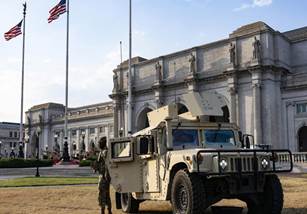
What do we make of the National Guard in Washington DC? The recent decision by President Trump to send the National Guard to Washington DC to support the Metropolitan Police Department (MPD) in addressing crime and the homeless situation has been met with widespread concern.
Controversy has centered around the use of federal power and its potential impact on local governance and civil liberties. Critics argue the deployment of circa 800 National Guard troops (from 300-400 from West Virginia, 200 from South Carolina, and 150 from Ohio) is an overreach of presidential authority, a power grab aimed at intimidating the city’s residents and government, as well as an effort to undermine local control. They point to the fact that the rates of violent crime have been steadily decreasing, thereby questioning the decision to federalize the MPD and deploy troops – especially given statements by the Administration that it is planning to do the same in other cities.
These steps have been met with not only criticism in the press and by Congressional and State leaders – as well as the DC government officials – but also with protests in Washington DC. Tensions are high despite the MPD having erected barricades between themselves/National Guard troops and the protestors. And there is growing fear that things could escalate into violence.
From an Administration point of view, while there was no specific incident that led to the deployment of the National Guard, senior officials explain it was a long time in coming due to rampant criminal activities across DC.
Officials have also attempted to deescalate the situation by explaining the realities related to the deployment.
- Not armed: Officials point out the National Guard troops are not/will not be armed, despite recent statements explaining that they could be armed depending upon the nature of the deployment.
- That said, recent statements in the media point to officials state some troops may be armed.
- Analysts note this should not be seen as a surprise as this is required given those involved are from the military. As such, the statement is seen to moderate any possible reaction/political spin this could take during the operation.
- Deterrence: Rather than engaging in active arrest operations, the goal of this deployment is for the troops to act as a deterrent to gangs and other criminal elements, as well as establish a presence near to/around federal facility. They are also present to support efforts to remove homeless encampments across the city – to clean up the area and ensure those removed are taken to shelters and other support facilities.
- No arrest authority: The deployment was seen as a way to support the MPD in its efforts across the District. The troops have no arrest authority – leaving this to the MPD.
Longer goal of the Administration
While the short-term goal is to address the two issues affecting Washington DC, there are some longer-term issues as well:
- Not waiting for approval to act: Like with so many other recent decisions taken by the Administration, the implementation of plans to deploy the National Guard was taken to not only realize action on the ground quickly, but also to test the limits of the Executive Authority of the President.
- The Administration knew this decision would not only result in widespread criticism, but also likely lead opponents to raise it to the Judiciary.
- For senior Administration officials, this is important as it will allow them – and the system – to clarify the extent of Executive privilege; something the President continues to explore. And current officials are confident any judicial decision will find in their favor.
- Where next? DC was chosen specifically because of its status. As such, the ability of the Administration to act is somewhat easier as it does not have to contend with states’ rights issues.
- And while court cases have already started, it is believed the intent is to illustrate the full authority of the President, as well as to justify the Administration in conducting similar operations in other states.


Challenges with China’s economy, but efforts to attract talent continue: A few recent economic developments are showing both the positive and negative challenges facing China.
China’s export prices have increased for the first time in two years.
Per recent data, in June, export prices rose 0.5% y/y, snapping a prolonged 25-month contraction streak.
By way of background, while plagued by overcapacity, China’s industrial sector has slashed prices and dumped surplus production on the international market, infuriating trade partners.
- Average export prices have fallen circa 13% since 2022, with far deeper price cuts in sectors where overcapacity is particularly prevalent – like solar panels and autos.
June’s uptick in export prices came off the back of industrial machinery and equipment:
- Metalworking machinery increased 8.9% y/y.
- Electrical machinery rose 5.5%.
- Industrial equipment increased 2.9%.
Prices for lower-value manufactured goods also ticked up:
- Furniture rose 7% y/y.
- Toys, games, and sports equipment climbed 3.7%.
- Footwear increased 3.6%.
Analysts contend that after more than two years of relentless price cuts, even modest export price gains will help shore up industrial profits and take some heat out of trade tensions over cheap Chinese goods.
That said, export prices are at multi-year lows, meaning part of June’s price increase reflects base effects, rather than a genuine improvement in pricing power.
Furthermore, facing the threat of tariffs and other trade restrictions, exporters are expected to cut prices further in the coming months to maintain competitiveness. That means June’s price increase will be an outlier, rather than representing a genuine bottoming out of export prices.
Relatedly, consumption has slowed – as noted in July statistics. As for the reason, analysts explained automobiles and restaurants are mainly to blame.
- Retail sales of consumer goods grew 3.7% y/y in July, the slowest rate of expansion since December 2024.
- Retail sales of services grew 4.6% y/y, the slowest growth rate in 14 months.
Consumer goods growth was dragged down by contracting auto sales, which account for roughly 11% of retail sales.
- Auto sales declined 1.5% y/y in July, marking the first decline in five months.
Meanwhile, big-ticket sales grew strongly, supported by the government’s trade-in program.
- Home appliances sales grew 28.7% y/y.
- Furniture sales grew 20.6%.
- Mobile phone sales phones expanded 14.9%.
However, driven by the outsized impact of auto sales, aggregate growth of big-ticket items slowed to 5% y/y – the slowest rate in five months.
On a seasonally adjusted month-on-month basis, retail sales shrank 0.1%, marking the second consecutive m/m contraction.
Meanwhile, sluggish catering sales were the main factor dragging on service sales growth.
- Catering sales only edged up 1.1% y/y, largely a result of the Party’s overzealous clampdown on official banquets and dining.
Analysts believe the consumption slowdown is concerning, but they do not expect policymakers to panic. Beijing will only push out a consumption stimulus once it can confidently answer “no” to at least two of the following questions:
- Is China’s surging export growth sustainable and sufficient to substitute for lagging domestic consumption?
- Can the consumer goods trade-in program continue enhancing the sale of big-ticket items?
- Will the recent service sector policy support reverse July’s service sales slowdown?
- Will the recent push to tackle overcapacity draw a line under falling prices and falling price expectations?
Finally, despite uneven economy news – with more to come – China continues to look for any/all advantages to undermine the dominance of the U.S. in the international economic market. And nothing is deemed more important in this regard by the Chinese leadership than identifying and attracting talent to China from the U.S. and Europe.
Along these lines, analysts noted the State Council recently announced the creation of the “K Visa,” designed to attract scientific talent.
- The K Visa program will provide significant flexibility to scientists and technology professionals seeking to explore opportunities in China.
- K Visa holders can engage in exchanges in education, science, technology, culture, and other fields, as well as in entrepreneurial and business activities.
- Applicants do not need employment or an official invitation from a Chinese organization.
- The requirements include a minimum undergrad degree from a top university in a relevant subject – science, technology, engineering, or math – or research work history at a similar institution.
This is seen by analysts as a concerted effort by China to exploit efforts by the Trump Administration to target universities in the U.S., as well as ban foreign students from entering the U.S.
That said, analysts point out this is not something new. China’s efforts to recruit foreign talent are longstanding – indeed, the infamous “Thousand Talents” program was hugely controversial in the U.S. due to concerns about tech transfer and efforts by Chinese intelligence to use the program to advance its collection efforts. For U.S. officials, there is little concern related to the K Visa program. While the Administration is taking a harder line of student visas, they are quick to point out that for those students who legally want to study the pathway remains open. And while China is expected to offer incentives to attract students, it is contended that U.S. universities remain the best and most advanced – offering opportunities and freedoms not available via the Chinese system.