

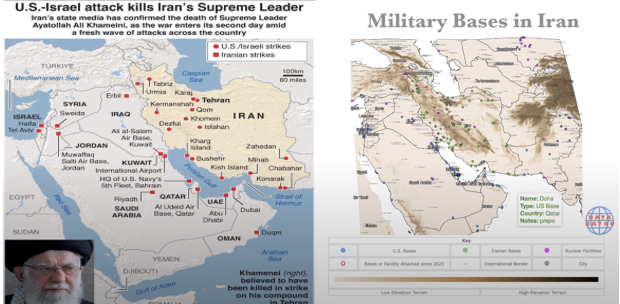
Senior officials explain that the situation in Iran remains fluid, but the U.S. and Israel have three primary goals at present:
- Destroy and diminish the ability of Iran to retaliate against U.S, Israeli and Gulf States targets.
- Degrade and destroy leadership nodes and facilities – to include targeting senior political, defense and security figures.
- Encourage opposition groups and protestors to support U.S. and Israeli efforts toward regime change.
The key for the U.S. and its allies at this point is to secure the transition of the government to a deradicalized group capable of stabilizing the domestic political, military and security apparatus in Iran in line with the initial goals – i.e. ending Iran’s nuclear and missile programs, as well as its support for proxy states.
Assessments & Forecast:
- The confirmation of the killing of Khamenei, who was targeted in a precision strike along with multiple other Iranian political elite figures, reflects the “gloves-off” approach Washington and Jerusalem embraced. It underscores a willingness to continue targeting Iran with the goal of both denying its attack capabilities and destabilizing the Regime’s foundations and command-and-control structures.
- The military campaign against Iran will likely continue for the coming period – driven by Iran’s response.
- According to officials, Israel has obtained aerial superiority over Tehran, leading to a subsequent uptick in Israeli airstrikes in the capital.
- There are no indications that Iran’s military or security services have/are starting to fail as institutions or that their ability to respond/retaliate has been undermined.
- Efforts by Iran continue to be focused primarily against U.S. and Western military targets across the region – with civilian areas affected primarily by debris from intercepted drones/missiles.
- Analysts believe that while military targets remain the primary focus of Iran’s retaliatory efforts, Tehran retains an interest in not only targeting military bases but also creating the price-tag effect on the countries and populations of the region to create leverage for Israel and the U.S. to stop their campaigns.
- This also echoes pre-war threats issued by Iran that multiple strategic civilian sites – such as Dubai’s Internet City, Silicon Oasis, Jebel Ali Port, and indeed the Dubai Airport – would be targeted.
- The death of Supreme Leader Khamenei will be leveraged by the Iranian Regime as a rallying cry to the Shia and Islamic community – especially as it took place during the holy month of Ramadan. Already analysts have seen protests spring up across the region against the U.S. and Israeli attacks – with the most prevalent taking place in Pakistan and Iraq.
- The former witnessed hundreds attack the U.S. consulate in Karachi, leading to U.S. Marine Guards and police killing 9 protestors.
- Iran has taken some limited escalatory actions, including reported attacks against an oil tanker around the Strait of Hormuz, an earlier attempt to launch missiles against UK/U.S. bases in Cyprus, and its drone attack against the Duqm Port in Oman.
- This constituted Iran’s first assault against the Sultanate, leading the U.S. Embassy in the country to issue a shelter-in-place guidelines for U.S. citizens in Oman.
- This is notable due to the fact that many evacuations from targeted Gulf states currently occur through Oman.
- As of yet proxy states/groups have not responded in any meaningful way to the U.S. and Israeli attacks. While the death of Khamenei could serve to motivate attacks by the Houthis and Hizballah, analysts believe these groups remain in a wait-and-see mode.
- Hizballah – It is unlikely Hizballah will engage in any significant or meaningful attacks against Israel or the U.S. from Lebanon in the near term. The group continues to reel from earlier attacks which devastated its leadership ranks and its capabilities – much more than initially assessed. Also, Hizballah does not maintain the level of support it once did in Lebanon – with most Lebanese growing weary of fighting and searching for an exit strategy that will allow the country to rebuild its economy and financial infrastructure/system.
- That said, it is possible Hizballah could engage in operations via its cells located in Europe and the U.S., as well as across Latin America – targeting U.S./Western interests.
- Houthis – While the Houthis have been more of a wildcard vis-à-vis attacking Israel over the previous years, they are also aware that the ramifications of them entering this current fighting could undercut their domestic positions as Iran will not likely be able to support the group moving forward.
- Hizballah – It is unlikely Hizballah will engage in any significant or meaningful attacks against Israel or the U.S. from Lebanon in the near term. The group continues to reel from earlier attacks which devastated its leadership ranks and its capabilities – much more than initially assessed. Also, Hizballah does not maintain the level of support it once did in Lebanon – with most Lebanese growing weary of fighting and searching for an exit strategy that will allow the country to rebuild its economy and financial infrastructure/system.
- Iran is unlikely to run out of ammunition in the near term. Even after recent exchanges, analysts estimate Iran’s remaining medium‑range ballistic missile inventory to be in the low four‑figure range, with total ballistic stocks probably well above that and supported by 100–350 launchers and hardened underground infrastructure.
- Iran’s mix of short‑ and medium‑range systems – out to around 1,200 miles – gives it the ability to hold Israel and all major U.S. regional bases at risk, which is why it is still assessed as fielding the largest and most diverse ballistic missile force in the Middle East.
- At the same time, repeated strikes and interception losses are clearly eroding both its usable inventory and some elements of its launch architecture.
- As for resupply, sanctions have pushed Iran toward domestic production rather than simply cutting it off from missiles altogether. Over the past decade it has built an internal industrial base for propulsion, guidance, and airframes, so most serious assessments now treat Iran as largely self‑sufficient in missile manufacturing capacity rather than dependent on foreign deliveries.
- That does not mean its production is limitless or immune to disruption, however, sustained U.S. and Israeli efforts to target launchers, production plants, and key suppliers will gradually reduce the rate at which Iran can replace expended systems.
- While there is a possibility of China or Russia providing support, in the current environment it is not likely.
- For China, such active support against the U.S. would likely lead Trump to escalate tensions with the PRC, which have been on a positive trajectory in the lead up to the April Summit.
- For Russia, while it has provided Iran with support in the past, becoming actively involved in a fight that targets both the U.S. and Israel could undermine other issues at play – notably Ukraine as well as Russia’s ties with Israel
- Cyber attacks and operations are more likely to be taking place in the near term – targeting U.S., Israeli, Western and Gulf interests.
Oman
On 01 March, the U.S. Embassy in Oman issued a shelter-in-place alert for all employees and U.S. citizens in the country due to “activity ongoing outside the city.”
Oman’s news agency confirmed that two UAVs targeted the Port of Duqm in southern Oman, wounding one worker at the site.
Oman’s airspace remains open as of the time of writing
Israel & Palestinian Territories
IDF officials stated that the operation against Iran will continue as long as necessary, and that the IDF expects complex days and weeks ahead.
- Following a direct ballistic missile impact in central Tel Aviv during the late evening hours on 28 February, an individual was killed and at least 19 others were wounded.
- Iranian ballistic missiles struck the Beit Shemesh area, killing at least 8 and injuring at least 20 civilians.
- Overall, over 120 people have been reported as injured, including civilians and emergency responders.
On 01 March, Israel’s flag carrier El Al cancelled flight operations until 03 March at 02:00.
Iran
Israeli airstrikes continue to target Iranian targets, including in Tehran, as of 01 March.
Iranian authorities announced 40 days of mourning, following the Israeli killing of Ayatollah Ali Khamenei on 28 February in Tehran.
On 01 March, the IDF confirmed it eliminated 40 Iranian Commanders in the opening airstrikes of its campaign on February 28, including:
- Chief of Staff of the Iranian Armed Forces, Abdolrahim Moussavi.
- Commander of the IRGC Mohammad Pakpour
- Secretary of Iran’s Supreme National Security Council Ali Shamkani
- Minister of Defense Aziz Nasirzadeh
- Senior MOIS official Mohammad Baseri
- Commander of the Police Intelligence Organizaton Gholamreza Rezaian
- Chairman of the Organization of Defense Innovation and Research Hossein Jabal Amelian
- Head of the military office of the Supreme Leader Mohammad Shirazi
The initial assault by the U.S. and Israel targeted 500 sites with more than 900 strikes. Operations continue to focus on targeting military, leadership and security forces/centers to mitigate Iran’s ability to retaliate against U.S. and Israeli targets/bases in the region.
Syria
The Syrian Civil Aviation Authority announced an extension on the closure of Syrian airspace, including all flights transiting through Damascus International Airport or Aleppo International Airport, for 24 hours starting from 00:00 on 01 March.
The Ministry of Education suspended educational operations in Daraa, as-Suweida, and Quneitra Provinces on 01 March, as a precaution to preserve the safety of students and educational staff.
On 28 February, an explosion in as-Suweida city’s industrial zone killed five individuals and wounded several others. Syrian state media alleged that the explosion was triggered by unexploded ordnance belonging to the former Bashar al-Assad-led government. However, the National Guard asserted that the explosion was due to an Iranian missile.
Jordan
On 01 March, the U.S. Embassy in Jordan issued an advisory to shelter in place immediately, given reports of missile and rocket fire in Jordanian airspace.
As of the evening hours on 28 February, Jordan’s state news agency reported that the Jordanian Armed Forces (JAF) recorded 49 UAVs and ballistic missiles launched toward Jordanian territory. 13 ballistic missiles were successfully intercepted.
Jordan’s Public Security Directorate stated that it so far handled 73 reports of shrapnel falling and resulting in material damage as of the late evening hours of 28 February. These occurred in Amman, Zarqa, Jerash, Madaba, Irbid, the western Balqa governorate, Aqaba, and the central desert. It stated that no casualties were recorded.
Jordan’s Cybercrime unit stated that it is monitoring for accounts that publish false information to mislead the public or undermine state institutions.
The U.S. military continues to have A-10s warthogs based in Jordan to support operations targeting Iranian ground forces/armor.
Iraq
On 01 March, the Iraqi government reportedly declared three days of national mourning for the death of Iranian Supreme Leader Ayatollah Khamenei.
Security authorities reportedly downed four drones targeting the Imam Ali Air Base in Dhi Qar Governorate and five drones targeting military sites in Basra Governorate on 28 February. One soldier was wounded in Basra.
Iran-backed Iraqi militia Saraya Awliya al-Dam claimed that they had targeted U.S. bases in Erbil with UAVs in support of Iran and in defense of Iraqi sovereignty.
On 28 February, Iraq’s Security Media Cell stated that the Jurf al-Nasr area in northern Babil Governorate was struck twice during the evening hours. During the morning hours of 01 March, Iraqi security forces deployed riot dispersal methods and utilized tear gas to repel dozens of protesters attempting to cross Baghdad’s Suspension Bridge to storm the U.S. Embassy in the Green Zone.
On 01 March, Harakat Hezbollah al-Najuba spokesperson Akram al-Kabee stated that President Trump’s tyranny will not go unpunished, warning that the group will not stand idly by.
Kuwait
The Kuwait Ports Authority stated on 28 February that operations at the Shuaiba Port were suspended following the fall of debris in the area. It added that operations will resume when the situation assessment is completed.
The Kuwait Center for Government Communications issued a statement on 28 February, in which it announced that the Air Force intercepted several missiles targeting the Ali al-Salem Air Base. It also called on citizens to refrain from filming aerial attacks in the country or publishing such footage on social media.
On 01 March, authorities announced the interception of several projectiles within the operational area in the country’s south. No casualties were reported.
State media reported that the Stock Exchange will be closed on 01 March.
The Ministry of Electricity announced a partial power outage in several areas after power lines were struck by shrapnel from intercepted drones.
Bahrain
On 01 March 1, the U.S. Embassy in Manama confirmed that the Crowne Plaza Hotel in Manama had been struck by an Iranian UAV, resulting in an unspecified number of injuries. The Embassy issued a security advisory warning citizens to avoid hotels in Manama due to the threat of being targeted.
The General Command of the Bahrain Defense Force (BDF) stated that aerial defense systems had successfully intercepted 45 missiles and nine UAVs, including the Shahed-136 model.
The Ministry of Interior (MoI) confirmed that Bahrain International Airport (BAH) was struck by a UAV, resulting in material damage. No fatalities were recorded.
It also confirmed that three buildings in Manama and Muharraq were damaged during the evening hours of February 28 following a UAV impact and debris from an intercepted missile.
A fourth building was struck in Manama overnight. The MoI stated that there are indications that “high-rise buildings are being targeted.”
The MoI announced that authorities initiated legal action against a group who were accused of expressing support for “hostile acts” against Bahrain in a video circulated on social media.
The MoI also urged citizens to use main roads for essential travel to clear routes used by emergency services and preserve public safety.
Several Shiite opposition groups in Bahrain declared a period of mourning following the death of slain Iranian Supreme Leader Khamanei and urged mobilization to demonstrate in support of Iran and against the U.S.-Israeli operation. (Note: It should be noted that 85% of Bahrainis are Shia, while the government/leadership are led by the Sunni minority al-Khaifa family.)
Supporters of the opposition group Coalition 14 blocked roads by burning tire fires in Bani Jamra, located near the Budaiya Highway, on March 1. Mourning processions for Khamenei were held in al-Aker, Karzakan, Samaheej, Salmabad, and Sitra Island.
A Bahrain-based hacker group announced that in support of Iran, it had hacked several websites in Bahrain allegedly linked to the U.S. and Israel.
Qatar
As of the early morning hours on 01 March, the Ministry of Interior (MoI) stated that 16 casualties had been recorded so far in the Iranian attacks on Qatar.
The Qatari Ministries of Defense, Interior, and Foreign Affairs issued a statement calling on all citizens and residents to strictly adhere to safety precautions, rely only on official information channels, and refrain from publishing footage of any attacks or subsequent damage.
The Ministry of Defense stated that it had intercepted a large number of missile waves and UAVs. Two missiles struck al-Udeid Air Base, while a UAV targeted an early warning radar.
On 28 February, Qatar’s official news agency announced that remote work has been adopted across all ministries and government agencies.
On 01 March, Qatar’s Hamad International Airport has reportedly confirmed that flight operations remain temporarily suspended.
UAE
Abu Dhabi Airports stated that one individual was killed and seven others were wounded due to falling debris from an intercepted UAV that targeted Zayed International Airport (AUH) on 01 March.
The Dubai Media Office confirmed that a concourse at Dubai International Airport (DXB) sustained minor damage in an incident that resulted in four casualties. It added that due to the contingency plans in place, most terminals were already cleared of passengers.
The Dubai Media Office confirmed that shrapnel from an intercepted UAV caused a fire on the exterior of the Burj al-Arab Hotel. It later stated that debris from an aerial interception caused a fire at a berth at the Jebel Ali Port. No casualties were reported in either incident.
The Ministry of Defense stated on 28 February that Emirati air defenses had intercepted 137 ballistic missiles, destroying 132, while five fell in the sea since the onset of hostilities. It additionally intercepted 195 of 209 UAVs, while 14 fell within the UAE’s territory and waters, causing minor damage.
According to the state media, debris from drones intercepted by air defenses fell into the courtyards of two homes in Dubai, resulting in two injuries. Debris from intercepted drones also struck the facade of one of the Etihad Towers buildings
UAE’s Public Prosecution has warned against sharing information from unknown sources through social media, as this would lead to legal action.
The Emirates has suspended flight operations to and from Dubai until 15:00 on 02 March.
Persian Gulf/Gulf of Oman
On 01 March, the United Kingdom Maritime Trade Operations (UKMTO) stated that the maritime security environment remains highly volatile across the Persian Gulf, Gulf of Oman, North Arabian Sea, and the Strait of Hormuz, with ongoing regional military activity contributing to an elevated threat to commercial shipping. It warned of potential electronic interference, including disruption to AIS and other navigational or communications systems.
UKMTO further stated that claims regarding the closure of the Strait of Hormuz continue to circulate via open-source reporting and VHF communications; however, no official closure has been formally communicated to the maritime industry.
- On 01 March at 09:00 UTC, the UKMTO reported suspicious activity, stating that it had received a report of an incident approximately two nautical miles (3.7 km) north of Oman. The vessel’s crew has been safely evacuated.
- On 01 March at 09:50 UTC, the UKMTO stated that a vessel was struck by an unknown projectile 50 nautical miles (92 km) north of Muscat.
UKMTO is a British military-run maritime security office that supports commercial shipping in high-risk regions – to include the Middle East.