

@import url(‘https://fonts.googleapis.com/css2?family=Nunito+Sans:ital,opsz,wght@0,6..12,400;0,6..12,500;0,6..12,600;0,6..12,700;1,6..12,400;1,6..12,500;1,6..12,600;1,6..12,700&family=Nunito:ital,wght@0,400;0,500;0,600;0,700;1,400;1,500;1,600;1,700&display=swap’);
@import url(‘https://fonts.googleapis.com/css2?family=Handlee&display=swap’);
h3 {
font-weight: bold;
font-size: 18px;
color: #348089;
}
figure {
padding: 4px;
margin: auto;
}
figcaption {
background-color: #f4f5f6;
color: #404144;
font-family: ‘Nunito Sans’, Arial, sans-serif;
font-size: 14px;
padding: 10px;
text-align: left;
}
.pqFull {
display: block;
border-width: 2px 0;
border-style: solid;
border-color: #404144;
padding: 1.5em 0 0.5em;
margin: 1.5em 0;
position: relative;
font-family: “Handlee”, Arial, sans-serif;
font-size: 20px;
text-align: center;
color: #0067A6;
}
.pqFull:before {
content: ‘275D’;
position: absolute;
top: -.10em;
left: 50%;
transform: translate(-50%, -50%);
background: #fff;
width: 4rem;
height: 2rem;
font: 6em/1.08em sans-serif;
color: #666;
text-align: center;
}
.pqFull:after {
content: “2013 2003” attr(cite);
display: block;
text-align: center;
font-size: 18px;
color: #404144;
}
.highlight {
padding: 3%;
border-top: 8px solid #207BBC;
border-bottom: 3px solid #207BBC;
width: 100%;
font-family: ‘Nunito Sans’,Arial,sans-serif;
font-size: 15px;
font-weight: 500;
background-color: #EAF1F7;
margin-top: 25px;
margin-bottom: 25px;
}
.w3-container:after,.w3-container:before,.w3-row:after,.w3-row:before {
content: “”;
display: table;
clear: both
}
.w3-container {
padding: 5px;
}
.w3-col,.w3-half,.w3-third,.w3-twothird,.w3-threequarter,.w3-quarter {
float: left;
width: 100%
}
@media (min-width:601px) {
.w3-col.m1 {
width: 8.33333%
}
.w3-col.m2 {
width: 16.66666%
}
.w3-col.m3,.w3-quarter {
width: 24.99999%
}
.w3-col.m4,.w3-third {
width: 33.33333%
}
.w3-col.m5 {
width: 41.66666%
}
.w3-col.m6,.w3-half {
width: 49.99999%
}
.w3-col.m7 {
width: 58.33333%
}
.w3-col.m8,.w3-twothird {
width: 66.66666%
}
.w3-col.m9,.w3-threequarter {
width: 74.99999%
}
.w3-col.m10 {
width: 83.33333%
}
.w3-col.m11 {
width: 91.66666%
}
.w3-col.m12 {
width: 99.99999%
}}
.w3-row-padding,.w3-row-padding>.w3-half,.w3-row-padding>.w3-third,.w3-row-padding>.w3-twothird,.w3-row-padding>.w3-threequarter,.w3-row-padding>.w3-quarter,.w3-row-padding>.w3-col {
padding: 0 8px
}
Been to a security trade show lately? You may have noticed an uptick in the presence of drones and robots, from the rolling Dr. Who Dalek lookalikes to robotic dogs, to drones flying overhead. While they have been around for a while now, security integrators and end users are now taking a more serious look at the use cases for them — especially with the rapid rise of artificial intelligence that is enhancing the automation of both gathering and interpreting data.
“The biggest development is the shift from autonomy as ‘hardware moving around’ to autonomy as ‘software making decisions,’” says Steve Reinharz, CEO/CTO and founder, RAD Security, Ferndale, Mich. “We see the market moving toward agentic AI that can interpret events, manage workflows and drive consistent outcomes across many sites,” he adds, stressing that “autonomous” security can incorporate more than just drones and robots.
“It includes fixed AI security devices, autonomous access control workflows, automated event escalation, remote video monitoring automation and AI-driven incident response,” Reinharz says. “In our view, autonomy is ultimately about outcomes: detect, verify, deter, document and escalate with minimal human friction.” The company’s SARA (speaking autonomous responsive agent) is designed to be the hub of autonomous workflows, he explains.
Still, when most people think of “autonomous security,” their mind generally goes to robots and drones. That is where some exciting new ventures are happening in the security space, with solutions designed not to replace humans, but to augment them.
“Autonomous security is quickly moving from ‘interesting pilot’ to ‘operational necessity,’ especially as labor constraints and cost pressures continue,” Reinharz says. “The role is not to replace every guard or camera; it is to multiply the effectiveness of the entire security program.”
Axon, Scottsdale, Ariz., provides both proactive drones and drone detection solutions as part of its suite of security technologies. “By providing aerial visibility, [drones] help security teams make faster, smarter decisions, often before deploying personnel on the ground, says Mike Shore, senior vice president and general manager of enterprise at Axon. “This proactive, data-driven approach is gaining traction across industries. From enhancing employee safety and protecting assets to ensuring compliance and lowering operational costs, drones are enabling organizations to strengthen their security posture without overextending their resources. At the same time, their role is expanding beyond traditional security, unlocking new use cases in maintenance, inspection, and operational oversight that further drive ROI and long-term value.”
In the security integrator community, there are a few leaders on the vanguard of the robotic and drone developments, including Jake Shild, founder and CEO, LandSkyAI, Elmwood Park, N.J., featured on this month’s cover. Founded as an offshoot of his family’s company, Advanced Electronic Solutions, LandSkyAI’s mission is to work with end customers primarily on drone solutions, as well as to help fellow integrators with a pass-through solution. While the company is also interested in robots, Shild found that drones were an easier entry point for his company.
#ask-sdm-ec a {
display: inline-flex;
align-items: center;
gap: 10px;
padding: 10px 20px;
font-size: 16px;
font-weight: 600;
color: #348089;
background-color: #fff;
text-decoration: none;
border-radius: 4px;
border: 2px solid #348089;
box-shadow: none;
transition: all 0.25s ease-in-out;
}
#ask-sdm-ec a:hover {
background-color: #348089 !important;
color: #fff !important;
}
#ask-sdm-ec a svg {
width: 18px;
height: 18px;
stroke: currentColor;
stroke-width: 1.8;
fill: none;
stroke-linecap: round;
stroke-linejoin: round;
flex-shrink: 0;
transition: inherit;
}
Looking for quick answers on security topics?
Try Ask SDM, our new smart AI search tool.
Ask SDM →
“Even though we started with drones, we thought robots would be more popular,” Shild recalls. “But we realized it has been 90 – 95% aerial so far. There are great ground robotics we are working with, but drones can respond to emergencies faster and still do the same patrolling. With the ground robots, sometimes they are purposely moving at a walking speed because the sensors work better, and it is harder for them to respond to events quickly.”
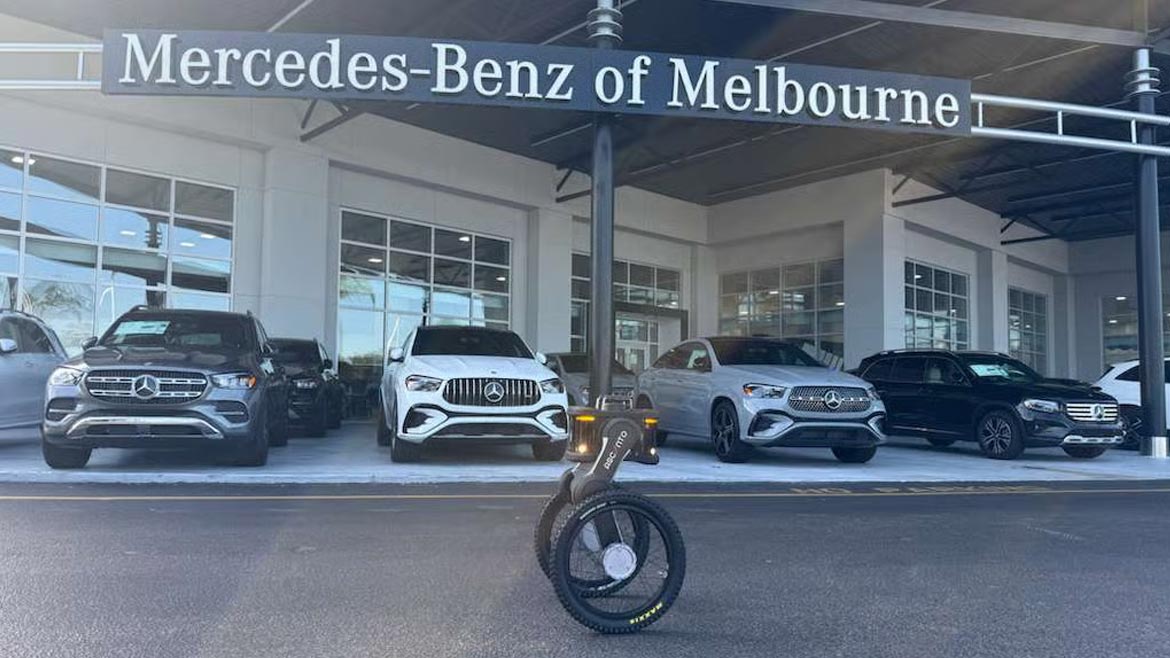
On the flip side of that coin is Michael Quiroga, founder and CEO, FC Robotics, Coco Beach, Fla. “We are the security integrator of the future,” Quiroga says. “It starts with the foundation of [ground] robots and expands from there. We do everything you can imagine from a technology perspective, as long as robots are involved in it. A robotic asset will be the smartest asset and tool of a layered security approach.”
At just 60 days old at the time of writing this article, Quiroga’s company is on the cutting, if not bleeding edge, but he is betting on ground robots taking off before drones — pun intended. “[Land robots] are moving at the speed of imagination, and aerial is moving at the speed of the FAA and government regulation,” he says. Like Shild, he is working with both land and sky, but he sees more potential initially for his company on the ground.
“Right now, the biggest opportunity for aerial robots is rapid response in a commercial or residential/HOA application,” Quiroga says. “It’s rapid response for alarms of any type of IoT sensors.”
Other integrators, such as Allstate Security, Amarillo, Texas, have been working with robotics even longer, using drones and video monitoring for virtual guarding applications. “We have been using these services since 2009 and have thousands of apprehensions across all 50 states,” says CEO Randall Renfroe.
Whether you are just starting to think about dipping your toes in the autonomous waters or simply want to learn ways to do more with them, below we examine both the land and sky solutions and where the providers of these solutions think this space is going from here.
We are the security integrator of the future. It starts with the foundation of [ground] robots and expands from there. We do everything you can imagine from a technology perspective, as long as robots are involved in it. A robotic asset will be the smartest asset and tool of a layered security approach.
The Robots Are Coming
The idea of robots has been capturing the public imagination since the early- to mid-20th century, but true implementation has been problematic. Anyone who has a robot vacuum and a pet knows the perils that can occur. In the security industry, there was the infamous robot in the water incident in 2017, when a popular security robot fell into a fountain while on patrol.
“One of the biggest challenges in this space is education,” Quiroga says. “We live somewhere between the Jetsons cartoon and CSI Miami when it comes to educating customers about what robots and AI automation can actually do for you. We did such a good job as a society promoting the allure but also did a disservice in not explaining what is reliable and possible.”
For his part, Quiroga is on a mission to change that. While his company is young, his experience in robotics is not, with a history of working with a couple of robotics manufacturers. “I left the manufacturing side almost three years ago and went into the private equity side for a while,” he says. “I wanted to answer the question, ‘If robots are so good and ready, why aren’t they everywhere yet? Why haven’t the traditional service providers and end users adopted it yet?’”
After two years in that role, Quiroga decided the best place to start was with his own service-based company. “I founded FC Robotics to prove out the thesis of human-machine teaming,” he says. While the company is hardware agnostic, FC Robotics is currently working with Swiss company Ascento as their U.S. distribution arm and, so far, has two pilot programs in Florida.
“The end users we are targeting are residential and lifestyle like HOA-gated communities, hospitality, etc.,” he says. “The common denominator is big pieces of dirt that are expensive to protect with traditional methodologies but have an elaborate budget or headcount of physical guards.”
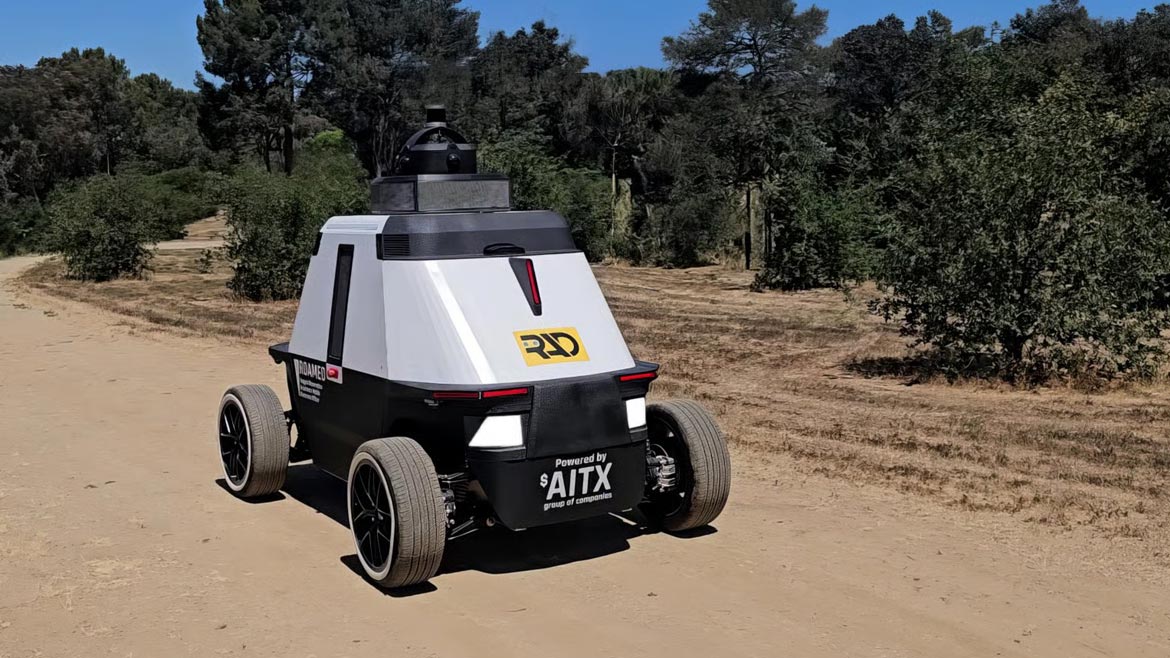
Guard augmentation is a big use case for both robots and drones, Reinharz says. “End users are deploying autonomous solutions to extend coverage, reduce guard dependency and standardize response across multiple locations,” he says. “Common uses include perimeter patrol, after-hours facility sweeps, parking areas, construction sites, remote yards and sites with chronic nuisance activity. ROAMEO [the company’s mobile autonomous patrol robot] is especially useful where you need mobile presence and repeatable patrol routines.”
Austin Smith, CEO, OneWatch Solutions, Indianapolis, is a RAD security dealer looking to scale the ROAMEO in large campus environments. “We began pursuing autonomous security solutions as a way to optimize operations and enhance command center capabilities,” he says. “The ability to be in multiple places at once is a major force multiplier, especially as clients look for stronger coverage without linear increases in staffing costs.”
Like Quiroga, Smith acknowledges one of the biggest challenges is still educating end users. “Introducing clients to a new approach to security requires walking them through the process, outcomes and long-term value. Once clients understand the opportunity, adoption becomes much easier.”
This education often takes the form of consultative selling, which is something all security integrators are very familiar with. “We conduct discovery sessions to understand operational goals, budget constraints and risk profiles,” Smith says. “From there, we evaluate what makes the most economic and operational sense while ensuring the solution enhances presence and effectiveness. Our goal is customization — removing the ‘we can’t do that’ limitations caused by resource constraints.”
Being able to demonstrate ROI in a tangible way is helping Tim Keller, president, American Security and Investigations (a division of Marsden Security), St. Paul, Minn., find success with selling the RAD robotic solutions. “It’s becoming a significant part of our business,” Keller reports, adding that his company is using robots (as well as drone solutions) for incident response in industrial settings. “Robots can go in a room that might not be safe for a human,” he adds.
Keller’s company is primarily a guarding company that is now using AI-automated and monitored robotics to help augment and address the problem of the rising cost of labor. “We have the ability to bolt on this self-contained unit, and it works in the space, and we don’t have to go through the requirements of having to integrate it,” he explains. “It is AI monitored. There are rules that can have the AI call or text a live person, but there is no live human monitoring.
“We can focus on the things that need a human touch and let automation do some of the mundane tasks. Then we can offer the remaining officers a higher wage,” he adds. “It keeps clients’ costs neutral but leverages technology to make sure the officers are doing what they do best.”
This is an increasingly common scenario, Reinharz says. “We work with a mix of integrators, monitoring organizations and guarding service providers,” he says. “The direction is clear: autonomous hardware is becoming the edge, while SARA is the scalable engine that makes deployments easier to operate across hundreds of thousands of locations.”
We have many use cases for drones and video monitoring, but the best case is when anyone has supplies on a jobsite and needs 24/7 coverage without having to deploy a security officer. A drone can help reduce shrinkage by almost 100%.
Integrator Opportunities


Like many as-a-service offerings in the security industry, autonomous solutions provide security integrators with recurring revenue opportunities.
“We collect the highest RMR on these services,” says Randall Renfroe of Allstate Security. “These are by far the best services to generate higher RMR that you have ever seen.”
Austin Smith of OneWatch Solutions says his company is offering robotics in two ways: either as a technology or as a service, depending on the customer’s needs. “They create strong recurring monthly revenue (RMR) opportunities through monitoring, response and managed services,” he adds.
“It is a good RMR component,” adds Jake Shild of LandSkyAI. “We base it around a one-year minimum contract. The drone software/hardware is always leased out, and we bundle in services as part of that package as well.”
But the opportunity goes beyond just another RMR source. Those involved in the space argue that offering autonomous security solutions can position the integrator as a forward-thinking expert.
“Often times, integrators are taking on the role of assessing the needs of facilities who need increased security or surveillance and design systems of technology, from specifying and installing hardware to identifying opportunities for applying leading-edge technologies,” says Steve Johnson of Talkaphone. “The system architecture and integration are often handled by integrators. A valuable integrator stays on top of technology advancements and can advise and help design system solutions that incorporate a strategic blend of trusted elements and novel technologies.”
Customers are asking for platformization: one intelligence layer that crosses devices and sites rather than a collection of disconnected gadgets, adds Steve Reinharz of RAD Security. “Organizations are building stronger SOC and GSOC workflows, and autonomy fits naturally when paired with clear escalation rules.”
The integrator’s role in this trend, he adds, is to sell outcomes, not devices. “The conversation should be about verified events, faster response, fewer false alarms, measurable deterrence and operational consistency,” he says. “Set up the workflow, not just the hardware. Success comes from defining what ‘good’ looks like: which events trigger action, what SARA should do automatically, what goes to an operator, what gets escalated and how reporting ties to the customer’s KPIs.”
One opportunity that is evolving from autonomous solutions is the guarding space. Whether you offer guards already or simply look to partner with guarding companies on the technology, it is a growing field.
Tim Keller of American Security and Investigations describes how his company is selling the RAD solution as a primarily guarding company: “Usually, we can outright sell it like a traditional integrator. Most of the time, it is packaged into a solution. We will procure the equipment and get it installed. There are no true monitoring costs, per se, but usually an agreed-upon response plan that we fulfill. There may be an officer on site, as well, who will respond when certain conditions are met. Usually, it is combined with a human component.”
Keller notes that the lines between guarding and technology are getting blurry. “The security guard guys’ advantage is they have clients and contracts already, whereas the traditional integrators are focused on technology and innovation,” he says. “There is an opportunity for collaboration with guarding companies that don’t have technology scopes.”
Michael Quiroga of FC Robotics agrees. “We are in acquisition mode, looking to acquire some guarding companies to augment some of that initial human side of the house,” he says. But the opportunity is more than just the guarding companies themselves. “A lot of the verticals we are going after want to have the guards in-house, more often than not, to control the quality. We are seeing migration away from some of the guarding companies and leveraging technologies to third-party vendors and bringing guarding in-house where they can have a manageable staff and augment it with technology.”
This presents a good selling opportunity for autonomous solutions to those types of end users. “If [a customer] has more than one guard on site at a time, it is easy math in their head; if they are already paying for perimeter security, they understand it,” Shild says.
It’s a Bird; It’s a Plane; It’s a Drone
Drones, like their land-based cousins, are also being used to augment security. While much of the frequently-discussed opportunity in the drone space is focused on counter-drone or drone detection, the proactive drone space seems to have bigger challenges to adoption.
“On the aerial side, [the tool will be adopted] when it becomes an easy process for corporate environments or large-scale entities,” Quiroga says. “What we are finding is [end users] want to do this themselves, and they are waiting for when the easy button crosses to the regulatory side. … The drone use case is only going to be effective when it becomes an added tool for existing headcounts already manning various IoT sensors. … Right now, it is taking up more operator time than it is saving.”
However, Axon and other companies investing in drones today believe the time is now. With its Axon Air powered by Skydio solution, which provides proactive AI-powered solutions, and its acquisition of Dedrone in 2024, a leader in the drone detection space, the company covers both sides of the drone business.
“Across the security industry, we’re seeing drone and drone detection technologies mature from pilots into operational programs,” Shore says. “Dock-based drones, automated dispatch, and tighter integration with command platforms are enabling faster response with fewer personnel, enabling staff to focus on other key priorities. At the same time, organizations are recognizing that drones introduce new complexity in the airspace.
“As a result, recent advancements aren’t just about flying drones faster; they’re about combining real-time response with continuous airspace awareness,” he says. “Multi-sensor detection, AI-driven classification, and real-time integration into command platforms allow teams to understand what’s happening both on the ground and in the air. This combination is what makes drone and drone detection programs scalable, safe, and operationally viable across public safety, critical infrastructure, and large enterprise environments.”
Allstate’s Renfroe says his company has had a lot of success with drones.
“We have many use cases for drones and video monitoring, but the best case is when anyone has supplies on a jobsite and needs 24/7 coverage without having to deploy a security officer,” Renfroe says. “A drone can help reduce shrinkage by almost 100%.” As a full-line security dealer, Allstate also offers guard/patrol services and operates its own monitoring center. However, Renfroe says, “Drones and video monitoring have become some of our biggest services to date.”
Another use case for drones comes from a somewhat surprising source: Talkaphone, manufacturer of the blue light pillars found on many college campuses in America, as well as in parking garages and other areas where public safety is a priority.
“Our role in the movement toward autonomous drones for security purposes is our Emergency Phone + Autonomous Drone Integration,” explains Steve Johnson, president and CEO of the Niles, Ill.-based manufacturer. “We saw an opportunity to bring together our iconic Blue Light Emergency Phones … with the Sunflower Labs Autonomous Drone system.
“Our integration is a novel development in this space,” Johnson adds. The “Bee” drone can be deployed after someone pushes the button to surveil, enhance visibility or even escort someone to safety or their dorm or car. “A single Bee drone can support a network of emergency phones, covering up to a 600-meter radius from the Hive, over 250 acres,” he explains.
In addition to partnering with Sunflower Labs, Talkaphone is also working with LandSkyAI to deliver integration, compliance and operations support, Johnson says.
LandSkyAI’s model is a hybrid between working directly with end users and also working with fellow integrators, Shild explains. This is to help with the biggest hurdle for adoption, which is the training, regulation and insurance pieces.
“The idea behind LandSkyAI was, ‘How can we make adoption simple for security?’ We sell the full virtual guard package and bundle in our 24/7 pilot and monitoring team,” he explains. “We have the regulatory process figured out and a lot of the maintenance and remote support. We try to make it very easy for them to resell to their end users because they don’t have the time to become experts in drones and robots.”
Typically, Shild adds, drone manufacturers aren’t used to working with the integrator market and often don’t do anything to make sure they are comfortable with the technology or become involved in the training or regulations.
“We make it easier on the integrator,” Shild says. “They don’t need a full drone and robotics program, and they don’t need to do that research themselves. We can become the integrator’s drone and robotics program, so they don’t have to go through all that.”
While part of the company’s mission is to work with other integrators — and they have some large integration partners in place already — the majority of LandSkyAI’s business is direct to customer in a virtual guarding capacity, Shild says. “Our biggest target market is industrial, manufacturing and utilities,” he says. “Up to 50% of our business has ended up being high-net-worth properties and estates, or even a high-net-worth community. But our target is usually the industrial scenario. What works well is if they already have 24/7 guarding because it is a little easier to understand the cost. When we come in with the virtual guarding, they understand it.”

We make it easier on the integrator. They don’t need a full drone and robotics program, and they don’t need to do that research themselves. We can become the integrator’s drone and robotics program, so they don’t have to go through all that.
Words of Wisdom
SDM asked autonomous security providers, “What advice would you give security integrators who want get into this market?” Here is what they had to say:
“Be willing to let go of the old way of thinking about security and embrace the new wave that is already here. Autonomous solutions are not replacing security; they are enhancing it.” — Austin Smith, OneWatch Solutions
“If you are nervous to bring it up, bring us along. Even if you don’t think the end user will do it, I guarantee that, if you bring it up, they will think you are a more innovative company, just for the fact that you got out there and mentioned it.” — Jake Shild, LandSkyAI
“[Robots] are not 100% on their own. You have to add a human layer to this. AI technology is not meant to be a replacement tool. If you hear people say that, run for the hills. That’s how you end up with unsafe SOPs within security. How do we take this and make it safer? We can’t remove the human, so we need to ask: ‘How do we keep a human in the loop and work backwards?’” — Michael Quiroga, FC Robotics
“Stay on top of new technology because it’s obviously developing and changing quickly. But don’t discount proven security measures when designing systems. Human security, visible security hardware, signage and other proven measures still have their place. Think holistically about every point of a visitor’s journey and consider building systems and plans that include myriad tools.” — Steve Johnson, Talkaphone
“Position autonomy as a service layer that improves outcomes, not a novelty device. Get crisp on the workflow: who responds, when and what happens at each step. Lead with a phased deployment plan: pilot with clear KPIs, then scale quickly once outcomes are proven. Bring the customer’s monitoring team into the conversation early because operational adoption is where projects succeed or fail. — Steve Reinharz, RAD Security
What’s Next for Autonomous Solutions?
One of the biggest boons to adoption of both land and aerial solutions has been the rapid technology evolution of AI and generative AI. Many of RAD’s solutions, for example, rely on AI to self-monitor and identify anomalies — a feat that was much more challenging in recent history.
“AI is the difference between ‘a robot with cameras’ and an ‘autonomous security solution,’” Reinharz says. “Generative AI accelerates usability and decision support by making systems easier to operate, configure and scale.”
Reinharz describes the autonomous space as “past early adopter, but not yet mainstream.” He adds, “Many buyers understand the promise, but still worry about reliability, integration complexity and who owns the workflow. Solutions that simplify deployment and prove measurable outcomes are pushing the category into early majority.”
Shore agrees. “We’re moving out of the experimental phase and into early mainstream adoption for many use cases,” he says. “Public safety agencies, large venues, airports, and critical infrastructure operators are no longer asking if drones fit — they’re asking how to operationalize it responsibly.”
That is exactly what companies like LandSkyAI and others are hoping to achieve.
“LandSkyAI has been around since January 2023, and, I will say, the first year was slow,” Shild admits. “That was the evangelizing stage. But last year and the start of this year, there’s been a ramp up in customers and a lot more interest. It seems like it will stay on the trajectory of fast growth. It is on the roadmap for a lot of end users to implement drones and robotics.”
Keller believes the general acceptance of AI will help speed up the adoption of these solutions. “Everyone is getting more comfortable with AI; whatever resistance there is will diminish,” he says. “This is just the beginning. Technology continues to evolve, and we know the ability to detect potential problems will only get better, faster and more robust. What then?
“I think about the history of security cameras and the ability to have different functions like zoom and pan/tilt,” Keller adds. “What we have now is these sensors in a drone or robot, and it gives us a lot more flexibility to be able to place a sensor in locations not limited to fixed installations or even trailer solutions. How can we take all these proven concepts in the security world and have fewer limitations? It’s an interesting topic. There is a lot more adoption than there was five years ago. In the next few years, we will see even more dramatic changes. Having more tools available to security professionals to help clients solve problems is an exciting thing.”
Quiroga believes the industry is going to see robots and drones in a similar way to how it now views remote video monitoring. “I really believe we are at an inflection point where you have a force multiplication in operational methodologies,” he says. “It’s the big unicorn question. Right now, the cash cow is remote video monitoring, which gives a one-button seat that can monitor hundreds of sensors. … What no one sees coming is, when the robots land, it will be the most intelligent thing on that piece of dirt. That is where the monitoring will happen and will add another layer of filter with a bigger multiplication on that button seat. Will robotics take over remote monitoring? Does anyone see that coming? I am putting my money where my mouth is.
“Robotics are just the sexy thing,” Quiroga adds. “They are the physical embodiment of AI, a means to deploy the software and a tool in the toolbelt. But they are not 100% on their own. You still have to have a human layer to this. AI technology is not meant to be a replacement tool. … Ideally, that human is a higher-paid human, and you are able to get a higher technical person in that role.”
Renfroe adds, “We have thousands of thousands of these accounts across the U.S. We are constantly onboarding new accounts every single day of the week for the services because, for the first time in the history of the security industry, we are able to obtain apprehensions or cut false alarms on all sites now. This makes us better at our jobs and makes our attrition zero. We see that this will, more than likely, become the standard in the future as well. … In the next 10 – 20 years, alarm systems will be obsolete, and video, drones and robots will be the major services pushed, and false alarms will finally become a thing of the past.”
Johnson agrees. “I see the space growing, with more facilities choosing to augment their security teams with autonomous solutions,” he says. “I also think that there will be more merging of solutions to enhance security through pairing of ‘traditional’ solutions and future-looking technologies. Digital and physical solutions will become even more integrated to enhance the effectiveness of each.”
On the people side, Johnson does caution about the need to address privacy concerns and set restrictions on how data is handled. That aside, he adds, “I also think predictive risk, where AI looks at patterns in incidences, will help facilities make decisions on security staffing and investments going forward.”
In the end, the consensus is that integrators should consider these solutions, even if it seems like it is on the early side for end users.
“I think there is still plenty of room for increased adoption,” Johnson says. “Currently, I feel that those who integrate autonomous technology in their security efforts are seen as leaders and cutting-edge. But that window is closing, and, soon, if some AI or autonomous technology is not integrated into security protocol, they’ll be seen as behind the curve.”
AI is the difference between ‘a robot with cameras’ and an ‘autonomous security solution.’ Generative AI accelerates usability and decision support by making systems easier to operate, configure and scale.
https://www.sdmmag.com/articles/105134-autonomous-security-solutions-the-next-frontier