
@import url(‘https://fonts.googleapis.com/css2?family=Nunito+Sans:ital,opsz,wght@0,6..12,400;0,6..12,500;0,6..12,600;0,6..12,700;1,6..12,400;1,6..12,500;1,6..12,600;1,6..12,700&family=Nunito:ital,wght@0,400;0,500;0,600;0,700;1,400;1,500;1,600;1,700&display=swap’);
@import url(‘https://fonts.googleapis.com/css2?family=Handlee&display=swap’);
h3 {
font-weight: bold;
font-size: 18px;
color: #404144;
}
figure {
padding: 4px;
margin: auto;
}
figcaption {
color: #404144;
font-family: ‘Nunito Sans’, Arial, sans-serif;
font-size: 14px;
padding: 10px;
text-align: left;
}
.highlight {
padding: 3%;
border-top: 8px solid #207BBC;
border-bottom: 3px solid #207BBC;
width: 100%;
font-family: ‘Nunito Sans’,Arial,sans-serif;
font-size: 15px;
background-color: #EAF1F7;
margin-top: 25px;
margin-bottom: 25px;
}
.pqFull {
display: block;
border-width: 2px 0;
border-style: solid;
border-color: #404144;
padding: 1.5em 0 0.5em;
margin: 1.5em 0;
position: relative;
font-family: “Handlee”, Arial, sans-serif;
font-size: 20px;
text-align: center;
color: #0067A6;
}
.pqFull:before {
content: ‘275D’;
position: absolute;
top: -.10em;
left: 50%;
transform: translate(-50%, -50%);
background: #fff;
width: 4rem;
height: 2rem;
font: 6em/1.08em sans-serif;
color: #666;
text-align: center;
}
.pqFull:after {
content: “2013 2003” attr(cite);
display: block;
text-align: center;
font-size: 18px;
color: #404144;
}
Video health monitoring is another tool in an integrator’s belt that increases RMR and helps move security from a reactive safeguard to a proactive protector. Are end users’ cameras working? Are they facing where they need to be for the end users’ needs? Is the network functioning properly? Customers don’t want to worry about this. With remote capabilities and advancements in technology, integrators can take care of these concerns seamlessly.
However, video health monitoring isn’t always the first tool integrators whip out of their belt. Chris Brown, CEO, Immix, Charlotte, N.C., compares the benefit to an insurance policy. “You never need insurance until you need it,” he says. “You always think: ‘Why am I paying for this? I’m never going to use it’ — until the moment when you do.”
Video health monitoring is undergoing a shift from a beneficial add-on to an expectation from customers. Currently, the customers most engaged in video health monitoring include multifamily owners, REITs and commercial real estate operators, especially those managing distributed portfolios. “Before adopting proactive monitoring, they were dealing with undetected camera failures, recording gaps discovered during investigations, increased liability exposure and operational inefficiencies across multiple properties,” says Whitney Fraser, senior vice president of sales, Cloudastructure, Palo Alto, Calif. “In a portfolio environment, even a small percentage of offline devices can represent significant financial and reputational risk. Our customers want assurance — not assumptions — that their systems are functioning properly.”
Integrators have a lot to worry about. Video health monitoring isn’t much added stress, for three key reasons: it’s easy to learn and deploy, it supports RMR and it contributes to customer retention.
We look at it as a bit of an insurance policy. You never need insurance until you need it. You always think: ‘Why am I paying for this? I’m never going to use it’ — until the moment when you do.
1. It’s a Click of a Button
Asking, “How difficult is it for integrators to implement video health monitoring? What level of training is required?” garnered a few chuckles from manufacturers and integrators alike — because it’s so simple. “We try to keep our training requirements really low with the goal that everyone that has ever deployed a video surveillance system would be very comfortable and confident to navigate this kind of management platform,” says Brett Keller, business development manager, Speco Technologies, Amityville, N.Y.
“With a reliable manufacturing partner, it’s easy to deploy and manage a video health monitoring solution,” says Steve Burdet, manager, solutions management, Axis Communications, Chelmsford, Mass. “Choose a company that provides training, focuses on the user experience and wants to make accessing the capabilities of its tools intuitive. With the right technology and partnerships, you can start adding value and achieving positive outcomes in a short time.”
The biggest lift for the integrator is actually selling the product. “There’s a little bit of training in order to articulate the value to the customer and explain what the customer’s going to get and why they should pay a few extra dollars for it,” says Dean Drako, CEO, Brivo, Bethesda, Md. “They need to know how to price it, how to sell it, how to promote it. Otherwise, it’s pretty straightforward for the dealer.”
#ask-sdm-ec a {
display: inline-flex;
align-items: center;
gap: 10px;
padding: 10px 20px;
font-size: 16px;
font-weight: 600;
color: #348089;
background-color: #fff;
text-decoration: none;
border-radius: 4px;
border: 2px solid #348089;
box-shadow: none;
transition: all 0.25s ease-in-out;
}
#ask-sdm-ec a:hover {
background-color: #348089 !important;
color: #fff !important;
}
#ask-sdm-ec a svg {
width: 18px;
height: 18px;
stroke: currentColor;
stroke-width: 1.8;
fill: none;
stroke-linecap: round;
stroke-linejoin: round;
flex-shrink: 0;
transition: inherit;
}
Looking for quick answers on security topics?
Try Ask SDM, our new smart AI search tool.
Ask SDM →
Once the value proposition is realized, though, it couldn’t be easier for dealers. “Understanding the commercial aspect is the biggest lift — understanding how to communicate this to the end user, what they’re going to get, looking at those reports and being able to tie your service to that, both the monitoring service and the maintenance of this system itself,” says Erin Bullard, director of partner relations, Immix. “It is extremely easy to actually deploy and to create that ongoing stickiness and customer relationship.”
On the training front, Jason Caldwell, director of marketing and Guard Force accounts, Immix, says, “We’re talking minutes, not hours.” It all happens at the monitoring center level, he adds. “All they need to know is the concept of it. … Then, even from the monitoring center perspective, the ones that are actually going to be doing the onboarding of the solution, it’s still very simple. Click of a mouse.”
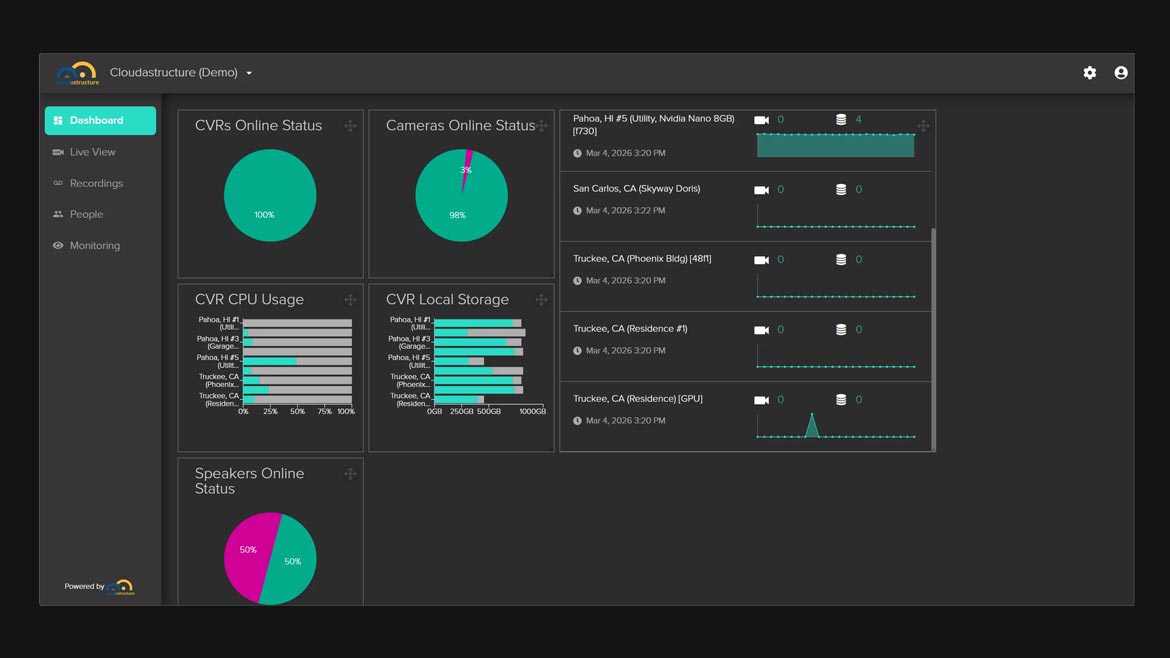
Integrators agree. With a cloud-managed infrastructure, Cloudastructure has been able to efficiently scale health monitoring across thousands of cameras. “Centralized dashboards, automated alerts and remote diagnostics allow us to monitor system performance across entire portfolios in real time,” Fraser says. “The key advantage is that monitoring is native to our platform — not bolted on. That architectural decision makes scaling seamless and cost-effective.”
With a reliable manufacturing partner, it’s easy to deploy and manage a video health monitoring solution. Choose a company that provides training, focuses on the user experience and wants to make accessing the capabilities of its tools intuitive. With the right technology and partnerships, you can start adding value and achieving positive outcomes in a short time.
Offerings on the Market
Axis Communications offers comprehensive video health monitoring across three levels: device-level intelligence, system-wide management and remote/cloud-based oversight. Axis solutions can detect a wide range of system health issues, including device outages, recording failures, network disruptions, storage and capacity constraints, hardware and environmental conditions, configuration inconsistencies, and potential security-related events. The company follows an edge-first philosophy, which Steve Burdet describes as a seamlessly integrated multi-layered ecosystem, openness and flexibility and a steadfast commitment to cybersecurity.
Brivo offers Eagle Eye Health Monitoring in both a standard and ‘plus’ version. Both are proactively managed services designed to ensure that video surveillance systems are functioning 100% of the time, optimally. The platform is supported by the manufacturer. Instead of putting responsibility back on the integrator or even the end user, Brivo takes on the majority of the responsibility and remedies issues that resellers and end users will be notified about, but don’t need to take any further action to resolve.
CHeKT, in a similar way to an alarm system supervising a door contact or a motion detector, supervises camera streams to ensure that the cameras are working properly and proactively communicates that into the monitoring center. Communication happens when the camera is disconnected, reconnected and even if it’s happening frequently, which can signify a network health issue. The company also supervises the camera’s metadata, which Wes Usie describes as supervising whether the camera’s “talking,” or detecting what it needs to within its proper field of view.
Immix partnered with Actuate, an AI provider, to cover the “last mile” of video health monitoring, ensuring that information isn’t just hitting the cloud, but also hitting the monitoring center — because Immix’s clients care, of course, about whether or not the camera is working, but they really care about whether or not they can see what they need to see in the monitoring center. With Actuate, Immix’s system runs on a four-times-a-day basis and checks for things like images coming through, weak or depleted connections, black screen, smudges, changes in the field of view and other primary issues that monitoring centers care most about.
Speco Technologies recently developed its SecureGuard dashboard with the primary goal to reduce truck rolls. With its cloud management solution, Speco focuses on camera health checks, hard drive health checks, network connection to the individual cameras and to the recorders themselves, as well as the nitty gritty of ensuring that its cameras and recorders are up to date and able to correctly receive and trigger notifications directly to the end users in case anomalies pop up.
2. It Seamlessly Supports RMR
What many integrators do with video health monitoring is package it into a subscription service or as an add-on. Everon, for example, offers standard health monitoring components that already create a base level of revenue. “We also have buy-up plans that can include human checks, firmware upgrades and additional network monitoring for an added service fee,” says David Charney, senior vice president, video, Everon, Irving, Texas.
“You are able to package monitoring into different service level agreements,” Burdet says. “A basic tier might include automated notifications, while a premium tier could guarantee a certain uptime, include remote remediation and provide regular system health reports. This creates options that suit a customer’s needs and provide predictable and scalable revenue for integrators.”
Brivo built its Video Health Monitoring Plus as a subscription service. “Customers pay monthly or yearly for it,” Drako says. “The dealers can package it up to be a core part of the subscription price, if they want. The dealer can even package up basically a warranty plan. … They tack on a little bit more for their service of going out and actually running any problems or fixing anything that the customer screwed up. Over time, you can transform your traditional one-and-done kind of business.”
Keller believes video health monitoring should create a strong foundation of service-based offerings to generate RMR. “We’ve seen others bundle system monitoring, remote support and even software services into a monthly service agreement to build out that security as a service,” Keller says. “We’ve seen integrators offer packages that include health monitoring, remote diagnostic and maintenance. We’ve even seen people bundle in firmware updates and device management remotely. It’s all about making sure that the units that are deployed in the field have the latest in cybersecurity measures and also the latest in feature sets.”
As an added bonus, video health monitoring can save money for the integrator. Truck rolls are expensive, and they’re even more expensive than they were just a few years ago. “As those costs are starting to increase, what we’ve seen a lot of our partners do is offer the first year, parts and labor included, with the purchase of a video surveillance or an access control deployment,” Keller says.
In the event a dealer offering this service actually has to visit the customer site once or twice within that first year, their profitability of that installation is significantly compromised. “If they’re able to try to address those truck rolls remotely before having to go on site, they get significant increase their profitability on that job site,” Keller says.
We’ve seen integrators offer packages that include health monitoring, remote diagnostic and maintenance. We’ve even seen people bundle in firmware updates and device management remotely. It’s all about making sure that the units that are deployed in the field have the latest in cybersecurity measures and also the latest in feature sets.
Evolutions in Video Health Monitoring
Video health monitoring is widely considered a nice add-on, and that’s it. But the conversation is shifting. “It will absolutely become standard — and expected,” says Whitney Fraser of Cloudastructure. “In fact, sophisticated buyers are already assuming proactive monitoring is included.”
Why? AI capabilities are driving even more benefits for video health monitoring. Imagine this: You’re an end user, and you want to know what’s blocking a fire exit. Your camera system, which is periodically checking images, can recognize if something is placed, or falls, in front of the fire exit that could block someone from getting out. An AI system can do this. “They’re going to begin to check the health of what’s in front of the image,” CHeKt’s Wes Usie says. “These services will include making sure shelves are stocked, making sure employees don’t leave mops and buckets in the aisleways and various other organizational pain points that had to be managed or behavior that had to be constantly reinforced to correct it. … Those services are already available, but in their infancy stages. The use cases for them haven’t even been imagined yet.”
In David Charney of Everon’s opinion, “There should be a base-level obligation but always allow room for scalable plans that can accommodate for additional components based on specific customer needs.”
Everon is already seeing use cases for deployable AI in video health monitoring. “Many of the AI filters we leverage or the VMS we deploy are able to serve as inputs to our health monitoring programs,” Charney adds. “The hardware and the network monitoring tools are fairly mature. The monitoring checks — for addressing how often customers should receive an alarm and what the absence of one might mean — are continuing to evolve in functionality. In the past, these have had to be home grown with custom datasets.”
As AI grows smarter, it will begin to learn a scene and distinguish between the scene itself changing, with no consequences to security, and actual threats. For example: Imagine, again, you’re an end user. This time, you have a camera watching the back fence of your building. There’s a train track outside of the fence, and, every day, a train goes by. That train goes by for 45 minutes. Today’s cameras might send constant notifications back to the monitoring center to say, “Something changed. Something might be wrong. Check it out.” With developing AI, that camera will learn the scene, understand that a train is going by, and either won’t send out constant notifications, or will send one saying something to the effect of, “There same train is going by. Business as usual.”
Steve Burdet of Axis Communications anticipates AI enabling more granular data analysis and extracting deeper insights from wider data sets. “As more devices become cloud-connected, access to preventive insights will also improve, allowing for more targeted system management,” he says. “This includes updating OS versions and identifying specific issues with devices. Additionally, these advancements will extend to localized and on-prem systems as computing capabilities increase.”
AI will also lend itself to more predictive maintenance, as more products leverage AI to anticipate device failures before they even occur. “As an example, as hard drives are starting to maybe overheat and they’re coming to their end of their shelf life, we can practically let our partners know that there may be smoke before there’s a fire,” Speco’s Brett Keller says.
Ultimately, customers will demand accountability, transparency and measurable performance from their security providers,” Fraser says. “Health monitoring will be the foundation of that expectation.”
3. It Strengthens Client Relationships
Similar variations of the following quote are practically the security slogan now: “Integrators should be true partners in business.” Video health monitoring supports this popular philosophy.
“Health monitoring helps you forecast your cost of ownership,” says Wes Usie, founder and president, CHeKT, Shreveport, La. “For example: You’re my customer. Instead of you calling me, angry, because a camera’s down and something bad happened, health monitoring allows that conversation to flip where I’m calling you to say, ‘We recognize there’s a camera down, and I can have a technician out there next Tuesday.’ It allows that service to be managed and scheduled on a proactive basis instead of reactive.”
For Cloudastructure, video health monitoring directly supports its overall value proposition. “We’re not selling cameras; we’re delivering uptime, risk mitigation and operational visibility. That distinction increases contract longevity, strengthens renewal rates and deepens executive-level relationships,” Fraser says. “When ownership groups see documented uptime reporting and proactive issue resolution, trust increases significantly. It positions us as a long-term strategic partner rather than a transactional vendor.
“We’ve also learned that executive stakeholders care deeply about measurable performance,” Fraser adds. “Providing visibility into uptime metrics and service responsiveness strengthens renewal conversations and supports long-term growth.”
Everon has had similar experiences with video health monitoring in the field. “We find that clients are willing to pay for that service and appreciate our additional identification, communication and resolution of their issues,” Charney says. “A major lesson learned is the need to design solutions with remote control capabilities so that we can prevent truck rolls and get clients resolutions as soon as possible.”
Integrators who sell managed services can consider video health monitoring as another option in their menu of services that has intrinsic value for customers. “As an integrator, you can say: Yes, we can monitor your cameras; yes, we can reduce your false alarms; yes, we can create efficiencies in labor for the monitoring center to be able to better service your account; and, by the way, we can also tell you if the integrity of your camera views is intact,” Caldwell says. “It’s just one more thing that gives you a real A to Z portfolio of services that you can offer those customers.”
Video health monitoring also contributes to a more efficient and profitable team for integrators internally. “Remote diagnostics and triage allow technicians to identify — and often resolve — issues without a site visit,” Burdet says. “This reduces unnecessary truck rolls and ensures that when on-site service is required, technicians arrive prepared, increasing first-time fix rates.”
https://www.sdmmag.com/articles/105372-why-video-health-monitoring-is-a-no-brainer