
9 February 2026
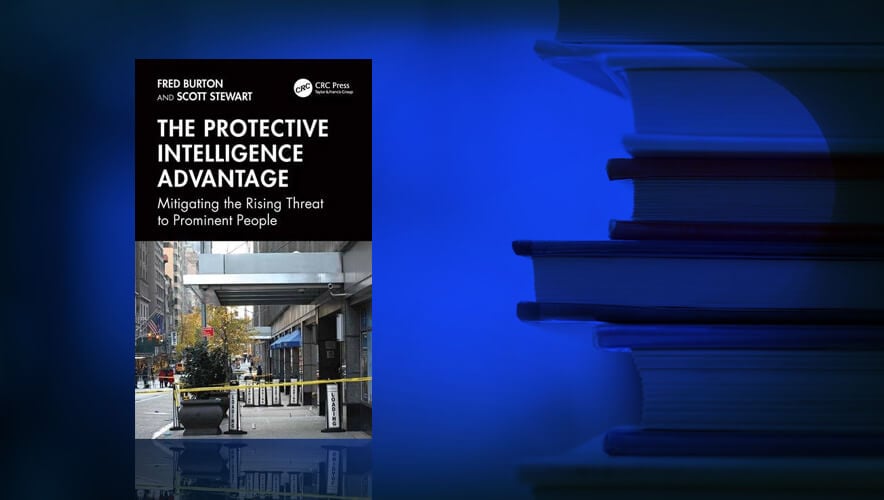
The Protective Intelligence Advantage: Mitigating the Rising Threat to Prominent People. By Fred Burton and Scott Stewart. Publisher: CRC Press; 222 pages; $49.99
Do you remember when you first heard the news that Brian Thompson, CEO of UnitedHealthcare, was shot and killed in Manhattan? That incident proved to follow the most current and impactful threat of those dissected by Fred Burton and Scott Stewart in this book, The Protective Intelligence Advantage: Mitigating the Rising Threat to Prominent People.
“In this book we will share protective intelligence lessons we have learned over our combined eight decades of executive protection and protective intelligence experience,” the authors write. “Using these lessons as a lens, we will examine the attacks against Brian Thompson and other prominent individuals to illustrate the need for protective intelligence tools. However, as we illustrate through the case studies outlined in the first eight chapters of this book, these attacks can be prevented using a few tools that any executive can learn and any company can employ.”
The eight case studies in the first half of the book are nothing short of fascinating. They equip students studying protective intelligence with important personal skills through real-life events.
The first chapter, titled “Denial in New York,” highlights Brian Thompson’s apparent total lack of awareness of the armed assassin lying in wait as the CEO briskly made his way down the street from his own hotel to another where he was scheduled to address an investors’ meeting.
The authors also relate the 2015 story of Savvas Savopoulos, the CEO of American Iron Works, whose Washington, D.C. home was invaded by an employee he fired 10 years earlier for threatening behavior. The attacker tortured his son to coerce money out of the CEO. Ultimately the assailant set fire to the house, killing the CEO, his wife, his son, and a housekeeper.
The subsequent eight chapters of the book provide the authors with endless opportunities to share lessons about mitigating the rising threat to prominent people. Burton and Stewart include chapters on understanding predators, discerning signs of threats, home and travel safety, and other vital topics, as well as a stern reminder that we must be responsible for our own security. The authors were generous in sharing with readers every bit of protective intelligence they have learned to keep their followers safe and secure of their own accord.
Reviewer: James T. Dunne, CPP, is a member of the ASIS Community for Executive Protection. Now retired, he was a senior analyst in the State Department’s Bureau of Diplomatic Security. The opinions and characterizations in this piece are those of the author and do not necessarily represent those of the U.S. government.