
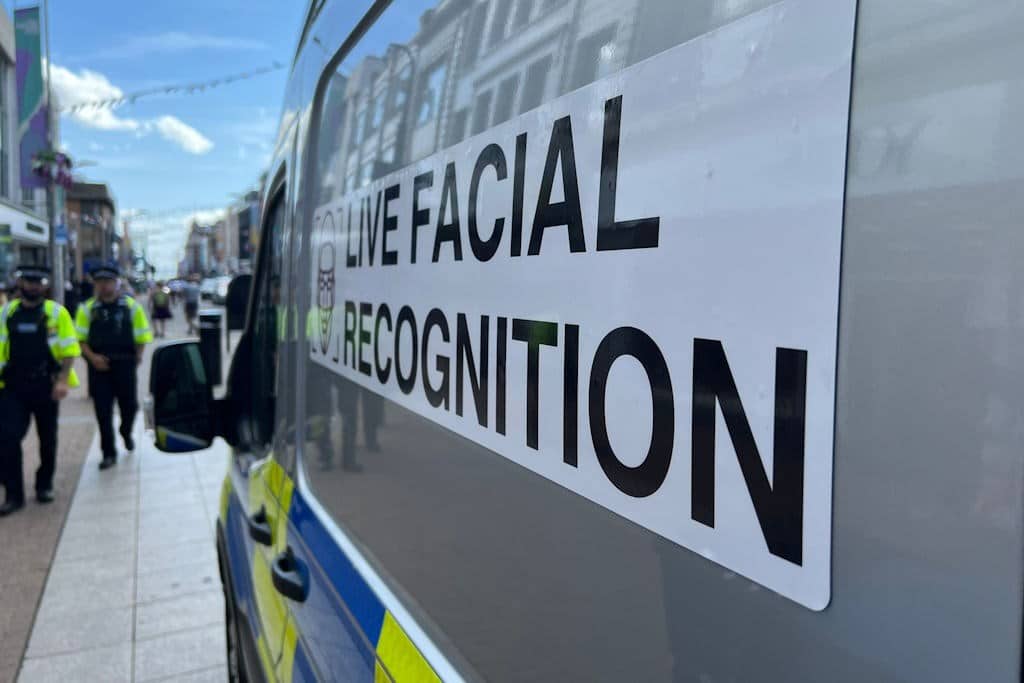
The UK government pledged on Thursday to increase its use of facial recognition and biometrics to identify wanted suspects. The pledge came as part of a massive and poorly-communicated information dump that reveals UK law enforcement is using face biometrics algorithms from Cognitec and Idemia, and a vague plan to overhaul the body responsible for biometrics oversight.
Proposed changes to the way UK police use facial recognition and other biometrics include more frequent use of the technology, but also possible police access to civil government databases like those used for passports and driver’s licenses.
Home Office announced the proposal, along with a 10-week consultation on a “legal framework for using facial recognition in law enforcement,” which takes in forensic (or retrospective) facial recognition, operator-initiated facial recognition (like in body cams) and live facial recognition.
The proposal also includes the creation of a new oversight and regulatory body for “police use of biometrics, facial recognition and similar technologies.” Home Office will gather views on what responsibilities this regulatory should have during the consultation.
Home Office says the consultation will consider the benefits of facial recognition, what safeguards are needed for it and “similar technologies which are likely to follow.” How the technologies should be used, privacy protections and proportionality will be addressed. The consultation opened Thursday and closes February 12, 2026.
Crime and Policing Minister Sarah Jones described facial recognition as “the biggest breakthrough for catching criminals since DNA matching.”
In response, Big Brother Watch Director Silkie Carlo said: “Facial recognition is indeed a powerful technology much like DNA, but we would never accept DNA checkpoints across our high streets and nor should we accept widespread face recognition checkpoints, treating us all like criminals in a constant line up.”
The announcement notes that Home Office spent £12.6 million on facial recognition last year, including £2.8 million on live facial recognition deployed in fixed-location pilots and vans. Another £6.6 million is budgeted for a further rollout this year, including £3.9 million for a national face matching service.
Home Secretary Yvette Cooper revealed in July that the Home Office was working on a governance framework for police use of live facial recognition.
Questions as proposal
The consultation paper says that while the government has determined a legal framework is already in place for police to use facial recognition, it is insufficient for police “confidence to use it at a significantly greater scale” or to give the public confidence that its use is responsible and according to clear rules.
It asks 17 questions about which technologies and organizations the new framework should apply to, what factors should be considered in assessing privacy impacts, what purpose the technologies should be allowed for and who should be responsible for authorizing the use of the biometric technologies.
Home Office also asks if police should be allowed to search public records like the government’s passport and driver’s license databases. Currently, they have to ask the Home Office to do so on their behalf, and the request has to meet a standard set of criteria.
Carlo from Big Brother Watch says the consultation is long overdue but that if the government was going to take the consultation seriously, it would halt police use of facial recognition pending its outcome instead of allocating funds for a program expansion.
Biometrics Commissioner role change
To oversee the expanded system, Home Office proposes the creation of a regulatory and oversight body which would “encompass and build upon the existing roles of the” BSCC and Forensic Science Regulator for England and Wales.
What this means for the Biometrics and Surveillance Camera Commissioner role is unclear. University of Stirling Professor William Webster was appointed BSCC effective November 1 after the biometrics role was left vacant for just under a year and the surveillance camera role continuously since last August.
The role is mentioned only once in the announcement, by Former Head of Counter Terrorism Policing Neil Basu.
“The live facial recognition system was, but no longer is, discriminatory but it will still require proper legal safeguards and oversight by the surveillance commissioner,” Basu says.
The consultation plan points out that the BSCC, the Information Commissioner, HMICFRS, Equality and Human Rights Commission, and the Independent Office for Police Conduct all currently play parts in overseeing police use of facial recognition, and argues the arrangement is inefficient.
“We believe that a structural change would make oversight more effective and propose creating a ‘one stop shop’ serving a common group of stakeholders with similar concerns and need for clarity.”
It describes a new role strikingly similar to the old one:
“We envisage giving this body the necessary powers to provide assurance that law enforcement use of biometric technologies is legal, responsible, and necessary. These powers could include setting standards to assure scientific validity, issuing codes of practice and investigating instances where a technology has been misused, hacked or accessed without authorisation.”
Cognitec and Idemia facial recognition evaluated by NPL
The government also asks how bias and discrimination should be prevented.
Home Office provides links to a new guide and factsheet on police use of facial recognition, and a survey on public support for facial recognition. It also links to newly-published tests on facial recognition carried out by the UK’s National Physical Laboratory. The new test by NPL were conducted with similar but updated methodology to the tests of NEC’s NeoFace in 2023 for London’s Metropolitan Police.
Cognitec’s FaceVACS DBScan ID v5.5 returns a correct match in more than 99 percent of searches at the operational setting used by UK police when a true match is in the gallery, according to NPL. The assessment found statistically significant variance in the performance of Cognitec’s algorithm at a face-match threshold of 0.8 between genders, skin color and older and younger subjects.
The Idemia MBSS FR algorithm used by Home Office and intended for use in the new national facial matching service was found to have “no significant demographic variation in performance,” with a true positive identification rate (TPIR) of 100 percent and a false positive identification rate (FPIR) of 0 percent for all groups at face-match thresholds between 3052 and 3981.
The Cognitec algorithm was contracted by Home Office for police to use with the Police National Database (PND), while Idemia’s algorithm is for Home Office’s own use and the proposed national service. NEC’s algorithm is still used by UK police for live (or “real-time”) facial recognition.
Related Posts
Article Topics
biometric bias | biometric matching | Biometrics and Surveillance Camera Commissioner | Cognitec | facial recognition | IDEMIA | live facial recognition | National Physical Laboratory | police
Latest Biometrics News
By Professor Fraser Sampson, former UK Biometrics & Surveillance Camera Commissioner Fears about AI-enabled biometric tools like facial recognition are often…
Deepfakes have advanced beyond the capability of leading software tools using vocal biomarkers to detect them. Fortunately, behavioral biometrics and…
Major technology firms and payment providers are racing to replace cards and phones with face, palm and voice biometrics. Payments…
ServiceNow has announced its intent to acquire identity security company Veza, in a move that a release says will extend…