
Investigators using FaceFirst® solved cases faster, uncovered more value, and built stronger cases against organized retail crime.
A Loss Prevention Research Council (LPRC) case study has demonstrated the substantial impact of FaceFirst®’s facial recognition technology on organized retail crime investigations, revealing dramatic improvements over traditional CCTV methods.
The study compared two investigators with similar backgrounds working the same case: one using FaceFirst® and the other relying on traditional CCTV reviews. The results were striking.
From Alerts to Answers
While most facial recognition systems stop at the alert, FaceFirst® continues where others stop — turning alerts into answers.
FaceFirst® transforms face matches into actionable intelligence, helping loss prevention teams connect patterns, accelerate investigations, and outpace organized retail crime.
The technology’s most powerful differentiator is its look-back capability.
Unlike systems that can only work from existing case data, FaceFirst® can search historical system footage to uncover every visit, every pattern, and every accomplice tied to a person of interest — even those never captured in a case file.
This unique ability to search the unknown is what turns data into investigative efficiency — giving investigators the tools to build meaningful, multi-location cases faster than ever before.
The Results: 6× Faster, 4× More Value, 32× More Efficient
The LPRC study compared performance across identical investigations:
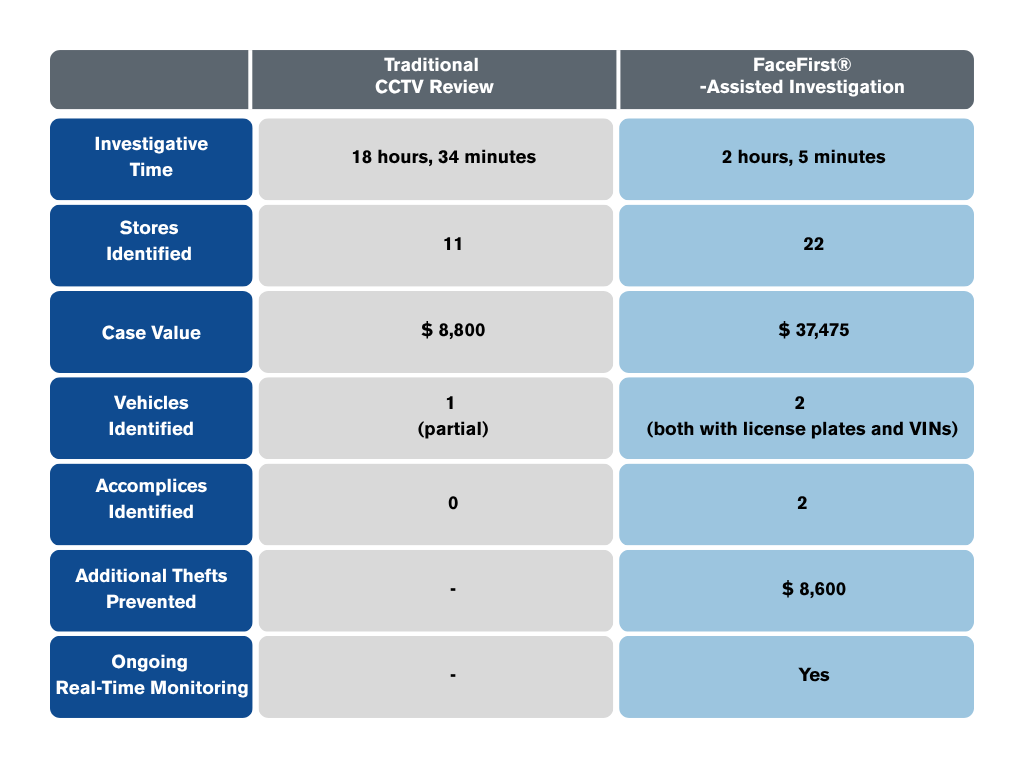
That’s an 8× improvement in time efficiency, 4× greater case value, and 2× more connected locations and vehicles.
When measured by time invested versus outcome achieved, the FaceFirst®-assisted investigator was 32× more efficient in terms of case value per hour.
The Power of Look-Back Search
Beyond real-time alerts, FaceFirst® delivers enduring value through look-back visitor search.
When a person of interest is identified, investigators can instantly review previous store visits, linked incidents, and potential accomplices — whether or not those moments were ever entered into a case file.
This capability transforms what used to be reactive investigations into proactive, intelligence-driven casework that spans past, present, and future.