
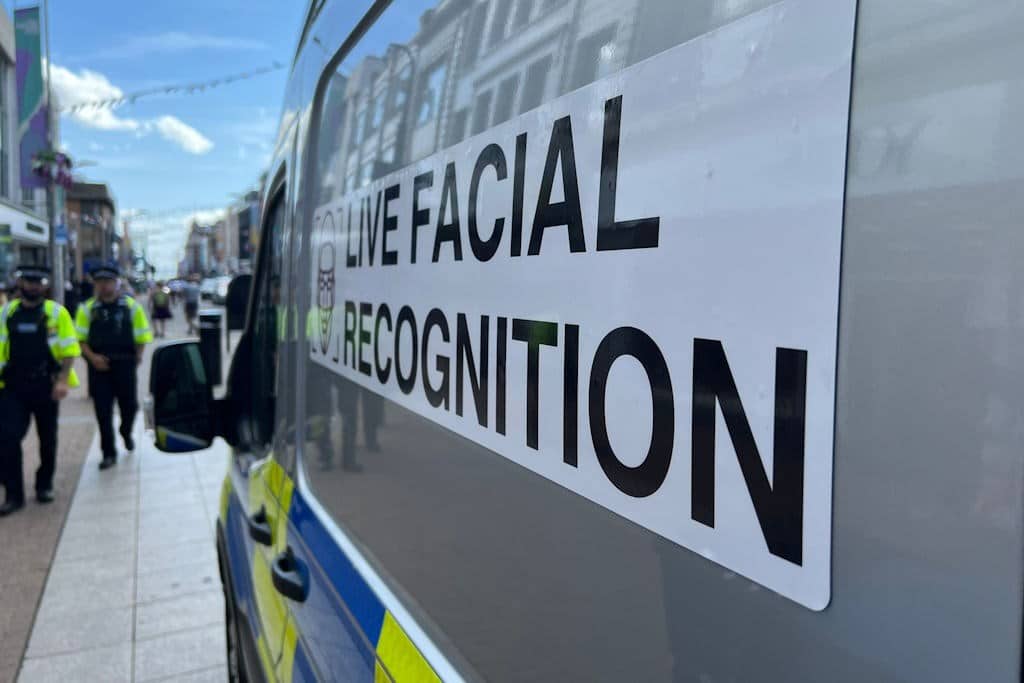
UK police authorities are expanding their live facial recognition (LFR) surveillance program, which uses cameras on top of vans to scan for people on watchlists in public places.
After London’s Metropolitan Police, South Wales Police and Essex Police, the technology is coming to Greater Manchester, West Yorkshire, Bedfordshire, Surrey, Sussex, Thames Valley and Hampshire. The funding for the 10 new vans will be funded by the Home Office over the next five years.
Greater Manchester police was the first to test the new system last Friday. The police force reported that the LFR helped them apprehend two offenders and locate a vulnerable man who had been reported missing.
On Wednesday, police in Surrey got their chance to use the system for the first time. The force pledged it would keep the deployments transparent. Signage will be set up to inform people they are entering a live facial recognition zone, while the police will notify the public at least seven days in advance. Results of the intervention will also be published.
“We want to be as open and transparent about our deployments, we publish them on our website at least seven days in advance, and we’ll publish the results afterwards as well,” Surrey Police Chief Inspector Andy Hill told The National.
Leeds police also joined this week, with the West Yorkshire Police deploying the vans. Alison Lowe, West Yorkshire’s deputy mayor for policing and crime, said the city authorities would continue to “scrutinise” police use of LFR, the BBC reports.
“Live facial recognition technology offers an innovative opportunity to help prevent and solve crimes, doing the work in minutes that could take officers many hours,” says Lowe.
The wide-scale LFR deployments have been met by criticism from digital rights organizations, which cite concerns over privacy and bias.
The facial recognition system relies on watchlists of wanted people and people subject to court orders. Images of people who are not matched with the watchlist will be automatically deleted. But groups such as Big Brother Watch warn that it’s not just criminals who end up on watchlists, noting that the technology is disproportionate and infringes on rights.
“People on these watchlists are not just restricted to serious crimes; it’s also victims of crimes and witnesses to crimes,” says Jasleen Chaggar, legal and policy officer at Big Brother Watch.
“If the police said, ‘we’re going to take a cheek swab of everyone on the high street just to check that they’re not who we’re looking for’, the public would rightly be outraged,” she adds.
The organization also noted that 10 people, of whom eight were black, were falsely alerted by the system.
The figure comes from the Met Police annual report, which lists more than 1,400 arrests linked to LFR use between September 2024 and 2025. The police force argues that the false alert rate remains low, standing at 0.0003 percent from over three million scans. No arrests were made following a false alert, the force notes.
Police in Surrey responded that they were aware that historically, there have been issues with facial recognition and gender and ethnic bias. The technology, however, has developed and the national algorithm provided by NEC shows no statistical bias.
“We appreciate that some people may have concerns about the technology, but I would like to reassure that it has been extensively tested by the National Physical Laboratory and has already been successfully used by police forces across the country over the last few years,” says Chief Inspector Andy Hill, Surrey Police LFR lead.
As LFR continues to spread across the UK, police in London are doubling down on the use of their surveillance vans. Last week, the force announced it would intensify deployments of the technology across the city, citing its effectiveness in identifying suspects and reducing violent crime.
South Wales Police and Gwent Police are likely to follow suit after winning a national policing award from the National Police Chiefs’ Council (NPCC) for their operator initiated facial recognition app.
Related Posts
Article Topics
biometric matching | biometrics | Essex Police | facial recognition | London Metropolitan Police | NEC | NeoFace | real-time biometrics | South Wales Police | video surveillance
Latest Biometrics News
Biometrics advances are culminating in new kinds of experiences for crossing international borders and getting through online age gates in…
The pitch behind agentic AI is that large language models and algorithms can be harnessed to deploy bots on behalf…
Let’s be frank: most biometric security hardware is not especially handsome. Facial scanners and fingerprint readers tend to skew toward…
A pair of deals for Idemia Smart Identity to supply biometric ID documents, one in Nepal and one in Armenia,…